Transgender individuals are more likely to experience mental health struggles due to discrimination and a lack of support. No one should struggle alone. This guide shares information regarding transgender mental health.
This guide was built by Benito, a former psychiatric crisis responder (MHP/CHW). While these materials were curated using professional crisis intervention frameworks, they are for educational purposes and do not substitute for personal medical advice.
If you are thinking about harming yourself or others, please get immediate support. Visit our crisis resources or contact the National Suicide Prevention Hotline for telephone, text, and online chat services.
Defining Mental Health: A Trauma-Informed Approach
Individuals are considered mentally healthy if they can:
- Cope with life stressors
- Visualize and improve talents
- Engage with their communities
There is more to being mentally healthy than just not being sick. Most people incorrectly associate health with the ABSENCE of sickness. According to the World Health Organization, “health is the state of complete PHYSICAL, MENTAL, and SOCIAL well-being and NOT merely the absence of disease or infirmity.”
By reframing our perception of health, we are empowered to take care of ourselves now. Health professionals recommend active steps towards healthy living rather than waiting until sickness in a practice called “preventative health.”
Health isn’t just the physical body either. To be healthy, we must take care of several aspects of our lives. It’s difficult to keep friendships if you’re stuck in bed; it’s hard to avoid sickness if your home or job is in a polluted area; and it’s tough managing anxiety if you’re unable to socialize.
Under a trauma-informed framework, health professionals are prompted to consider what life experiences formed one’s health conditions. Historically, doctors centered on diagnoses by essentially asking, “What’s wrong with you?” Reframing the question as “What happened to you?” gives providers a wider view regarding what experiences and traumas shaped their patients, creating better health outcomes.
Here are three examples of how trauma-informed care improves outcomes:
Trauma-Informed Care Example #1
Michael is a homeless man trying to get approved to stay at a local shelter. The staff working on Michael’s paperwork asks a lot of questions that he doesn’t know the answer to. Frustrated, Michael lashes out and yells at the worker.
Response A: The worker is offended and does not understand why the situation escalated so quickly. Since this paperwork is critical to allow Michael to stay in their long-term facilities, they assume Michael is either on drugs or does not want to put in the work required to stay there. They might even assume Michael is ungrateful!
Response B: The worker is offended but understands that many homeless people have had traumatic experiences that make them prone to stress. The lack of stable housing causes anxiety, and homeless individuals are statistically likely to have PTSD and suffer assault in comparison to housed populations. Michael behaved inappropriately, but the staff’s knowledge of trauma-informed care allowed them to recenter the conversation and de-escalate before making assumptions about Michael.
Trauma-Informed Care Example #2
Ruth is a lesbian woman working at a retail store. She is approached by an older customer, who wants to make small talk while they shop. Ruth obliges but becomes tense when the customer begins discussing their day at church. Abruptly, Ruth cuts the conversation off and leaves. The customer is confused and tells a supervisor about the strange interaction.
Response A: The supervisor is annoyed that Ruth left the customer mid-conversation. They assume Ruth has poor customer service skills and purposely failed to help the customer do their shopping. The supervisor might even assume that Ruth was judgmental and acted out because she disapproved of the customer’s faith.
Response B: The supervisor is annoyed that Ruth failed to help the customer, but they know that many LGBTQIA+ people have had traumatic experiences related to religion. Since Ruth is a lesbian, religious discussions may cause her stress or anxiety, even if the conversation would have been light-hearted. Ruth reacted inappropriately, but her supervisor’s knowledge of trauma-informed care allowed them to recenter their thinking before making assumptions about Ruth.
Trauma-Informed Care Example #3
Julius is a Black man who is stopped by a police officer while walking home from work. The officer asks him a lot of questions, making Julius increasingly anxious as he tries to get home to his daughters.
Response A: The officer sees Julius’ growing anxiety and assumes that he is hiding something. Julius does not answer their questions fully, wrings his hands, and does not make eye contact with the officer. The officer is suspicious and assumes that Julius is likely committing criminal activity.
Response B: The officer sees Julius’ growing anxiety but understands that many Black Americans have had traumatic experiences with law enforcement. Since Julius is Black, interactions with police officers may make him prone to stress and anxiety, even if he has not committed any crime. The officer’s understanding of trauma-informed care allowed them to reframe how they saw Julius, de-escalating the conversation before jumping to assumptions.
Mental health is affected by trauma, which can take different forms. Poverty, violence, and inequality are the most common reasons individuals develop risky behaviors and mental health conditions, which is why treating and managing mental health is challenging.
Additional Resources: National Alliance on Mental Illness | Mental Health America | American Foundation for Suicide Prevention | American Psychiatric Association | Active Minds | SAMHSA
Transgender Mental Health Services & Support Options
Immediate Transgender-Affirming Crisis Hotlines
Hotlines provide immediate free counseling, support, and information to callers. While some hotlines are telephone-only, many are available over text message and online chat.
Hotlines are confidential, but not anonymous unless specified otherwise. This means hotlines will use non-consensual active rescue to send emergency personnel to your location if they believe you are in imminent risk.
These services are best for crises, but are not ideal for long-term counseling. Hotlines are designed to help callers get through severe moments of distress, but are not equipped to manage mental health conditions beyond immediate crises.
Many hotlines are available 24/7, although this depends on agency size and funding. Here are curated directories of LGBTQIA+-affirming hotlines.
🏳️🌈 Global LGBTQIA+ Hotline Directory
🛡️ Global Sexual Assault & Domestic Violence Hotline Directory
🌱 Global Substance Use Hotline Directory
🏠 Global Homeless Hotline Directory
🎖️ Global Veteran Hotline Directory
🎒 Global Youth Hotline Directory
👵 Global Elder Hotline Directory
Peer Support Groups for Transgender Individuals
Support groups are recurring gatherings of individuals experiencing common issues like depression, substance misuse, and grief. Rather than seeking support solely from therapists, support groups provide people with encouragement, comfort, and connection from peers.
Support groups are frequently the most cost-effective therapy option, often free or low-cost. Unlike hotlines, support groups are a great option to manage mental health long-term because individuals obtain treatment through regular meetings.
These groups offer safe spaces to learn coping skills and self-care. However, they’re not for everyone. Each support group is run differently, but all groups should have clear rules and personal boundaries to allow everyone to share, feel at ease, and stay on topic.
Find a Transgender-Friendly Support Group
Interested in joining a support group? Use these tools to find a group near you.
Peer-Led Mutual Support Groups
Mutual support groups are peer-led. Groups are led by members, who are trained to be facilitators, but do not give professional advice.
Mutual support groups are the most casual type of support group. Although they cannot give professional medical advice, these settings allow individuals to share their experiences on what has worked best for their journey. Based on their organization, mutual support groups are almost always free to join.
12-Step Programs for Transgender Recovery
12-step programs use the original support group formula developed by Alcoholics Anonymous to connect individuals in peer-led groups without a professional facilitator. Although 12-step programs are associated with substance misuse, many programs exist for other mental health concerns.
Like mutual support groups, 12-step programs are free for individuals to join. However, 12-step programs utilize religion as a core aspect of programming.
Provider-Led Therapy Groups
Therapy groups are led by a mental health provider who connects individuals with similar struggles. Since therapy groups are facilitated by providers, they can provide professional counseling in a group setting. Individuals can obtain diagnoses and professional treatment without going to individualized therapy.
Some therapy groups are offered for free, but many cost a small fee. Group therapy is always cheaper than individualized sessions.
Virtual & Online Support Groups
Online support groups connect individuals through video calls and messaging rather than physical locations. Some groups may be peer-based similar to mutual support groups, while others may be facilitated by a mental health provider like therapy groups.
Similar to their traditional counterparts, many online support groups are free. Peer-based groups offer free membership, while online therapy groups require a small fee to offset the cost of professional care provided.
Telehealth Counseling & Virtual Therapy
You can receive professional counseling through a cell phone, computer, or other device connected to the internet. Historically, individuals had to visit counselors in person for therapy; the use of telemedicine allows users to access treatment remotely. Unlike online support groups, telehealth counseling connects people to one-on-one sessions with a trained professional.
Some individuals thrive with telehealth therapy. Some are unable to mesh well on a digital platform or obtain the level of support they need without in-person care. Always research your provider since some individuals operate via online platforms without licenses.
Telehealth therapy is not necessarily cheaper than traditional counseling. Telehealth provides more options, but the cost is based on insurance coverage. The best way to find a provider compatible with your healthcare coverage is through ZocDoc, although other platforms accept insurance.
Find a Transgender-Friendly Virtual Therapist
Interested in finding a telehealth counselor? Use these tools to find a professional for you.
Traditional Counseling & In-Person Therapy
Talk therapy provides clinical mental health treatment with a licensed professional to work through long-term issues. Unlike telehealth, traditional counseling requires individuals to visit providers in person.
When searching for a therapist, you should keep licensure, insurance coverage, and relatability in mind.
Every state has a list of requirements mental health professionals must complete to become licensed.
- It is possible to find counselors who provide treatment without a license. This is not advised since licensure ensures your counselor is qualified and up-to-date on inclusive and effective treatment methods.
- Medicaid, Medicare, and commercial healthcare insurance companies require treatment to be performed by a licensed entity to be covered.
Cost is a barrier for many. To lower the price of treatment, you need to make sure your coverage is compatible.
- Health professionals only accept specific coverage plans based on contracts their agency has signed. For your therapy to be covered, you need to find a counselor deemed “in-network” within those contracts. Most providers will have a published list of what coverage plans they accept.
- Even if your provider is in-network, more restrictions may apply. Some insurance plans only cover a set number of sessions or pay a portion of the overall fee.
- Without healthcare coverage, you will be expected to pay for each visit. Some counselors offer sliding scales for individuals paying out-of-pocket to cut down costs.
To find value and meaningful connection in therapy, you need to be able to connect with your therapist.
- Counselors specialize in certain fields. Based on their education, they may have more experience in CBT, psychotherapy, mindfulness, or humanistic approaches.
- A counselor’s background will determine whether they focus on specific topics, like religion, LGBTQIA+ issues, depression, or relationships. One therapist may be experienced in grief, while another is well-versed in PTSD.
There is no singular approach or counselor that is right for everyone. Approaches that work for one person may be terrible for others, as frustrating as it may be.
Find a Transgender-Friendly Therapist
Interested in finding a traditional counselor? Use these tools to find a professional for you. Alternatively, the Department of Health and Human Services maintains the HRSA Data Warehouse to direct users to federally funded clinics that provide therapy to low-income individuals.
Self-Care Strategies & Positive Coping Skills
Self-care isn’t just treating yourself; it is an active commitment to take care of yourself. If you don’t practice physical and emotional self-care, you will eventually burn out. It’s harder than it sounds.
Best self-care practices look different for each person. Your needs are shaped by your background, culture, and experiences: fancy chocolates and bath bombs might be great self-care for one person, whereas someone else might thrive on jogging and talking with loved ones. That’s normal!
Create a solid self-care plan to promote better mental health. Even if you’re unable or don’t want to seek professional treatment, self-care is a great DIY approach to mental health:
- Are you taking care of your physical body? This includes taking your prescription medication, drinking enough water, and getting out to exercise.
- Are you setting professional boundaries and goals at work? It’s okay to say no to avoid overcommitment, lean on others for support, and know your limits.
- Are you in a healthy environment? It’s difficult to stay healthy if you live in a polluted neighborhood or drink dirty water. Clean up your living spaces to be organized, fresh, and greener – or get involved with your community to volunteer.
- Are you financially healthy? Income uncertainty causes stress. Check your spending habits, set realistic goals, and start saving.
- Are you maintaining good relationships? You’re not obligated to keep toxic friendships. Spend time with others face-to-face and online in balanced moderation.
- Are you keeping your mind active? Build skills by reading interesting topics, watching new documentaries, or take one of your hobbies to the next level.
- Are you emotionally healthy? Practice mindfulness by reaching out to mentors and friends about your struggles, going for a walk, or meditating.
- Are you taking care of your fundamental values and goals? Even if you’re not religious, reflect on your current life position, whether you’re content, and where you want to be in the future.
Find things that calm you. Self-care only works if you enjoy what you’re doing. Most people suggest journaling and meditation, but self-care can be ANYTHING. Self-care can be listening to music, drawing, making bracelets, watching a comfort show, or playing video games.
Create a list of your current coping skills. These are habits to utilize when experiencing stressful situations. Expand your list and work on cutting out negative coping mechanisms. Unhealthy coping skills manage emotions, but negatively impact our lives. Unhealthy coping skills include things like substance abuse, anger outbursts, overworking, and self-harm.
There are five types of positive coping skills. No skill is inherently superior or better. It’s best to learn about several types and include any that work to your mental health toolbox.
- Problem-based coping skills force you to actively identify stressors, create ideas on how to change your circumstances, and take action with reasonable solutions.
- Emotion-based coping skills process emotions and work to reduce internal distress by reframing thoughts. These skills are especially helpful when encountering situations you can’t control.
- Religion-based coping skills use rituals like prayer to deal with stressors. By feeling connected to a higher power, individuals can relieve anxiety.
- Meaning-making coping skills reframe stressful situations for silver linings. When we can find meaning in our experiences, we find purpose despite stress and danger.
- Social support coping skills connect us to mentors, friends, and peers. Talking with support systems reduces stress, whether it’s feeling less alone by going to a support group or feeling valued after cooking a meal for a neighbor.
It is important to maintain a range of coping skills. There is no singular type that is perfect for all scenarios, and all coping skills can become negative if not practiced in moderation. Too much time spent on emotion-based skills makes people too reluctant to change situations where they can make a difference; too much religion-based coping becomes negative when folks put off dealing with problems by staying it’s God’s will.
Example of Coping Skills in Action
Tristan opens an email to find his annual performance review. He is surprised to see that the review states he is below average in several areas, even though he thought he had been performing well. Tristian becomes anxious and frustrated.
Problem-Based Approach
Tristan goes to his boss to discuss what he can do to improve his job performance. It makes him nervous to talk to her directly about it, but they develop a clear plan. Tristian feels confident about his ability to succeed.
Emotion-Based Approach
Tristian spends his lunch break reading a book to distract himself from making catastrophic predictions that he will be fired. After work, Tristian exercises and plays video games as a way to feel better. Tristian feels he can think about the situation more clearly.
Religion-Based Approach
Tristian goes to his local church after work. Tristian prays, reflecting on his purpose and relationships with a higher power by talking to his pastor. Tristian feels less anxious.
Meaning-Making Approach
Tristian spends time thinking about silver linings after work. He reflects on the meaning of his work and whether it makes him feel fulfilled. Thinking about his job options makes Tristian feel empowered to make new decisions to impact his life.
Social Support Approach
Tristian meets with friends after work for dinner. He vents about the review and emotions he is experiencing. His friends alleviate his fears of being fired and give advice on how to best improve his performance. Tristian feels supported by his loved ones.
Find Transgender-Friendly Self-Care Tools
Interested in learning more about self-care? Use these recommended apps and tools to practice self-care in your life.
How to Create a Personal Mental Health Safety Plan
Safety plans are pre-written personalized strategies to use when one is struggling with stressors. During a crisis, it is difficult to think of healthy coping mechanisms. Download Trans Soliary Project’s safety plan or create one with MySafetyPlan.org.

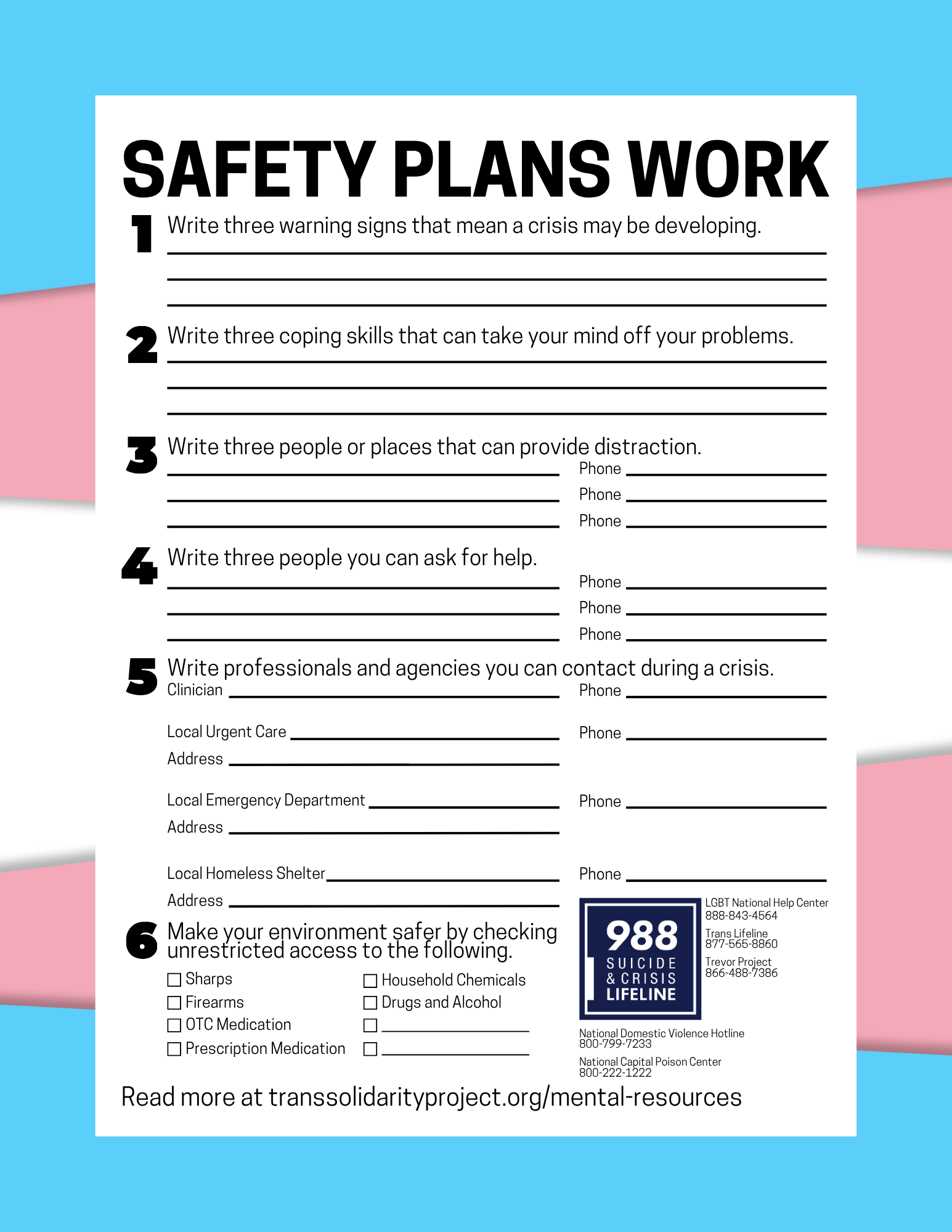
There are three things to remember when crafting your personal safety plan.
- Keep it doable. For your safety plan to work, you need it tailored to what suits you. Don’t put overly complex warning signs or coping skills too difficult to use in a crisis.
- It’s not written in stone. Writing down a skill isn’t a mandate. Your safety plan should be flexible; you can add or change items as needed.
- It doesn’t have to be completed in one sitting. Safety plans take a lot of emotional energy, so it’s natural to need a break before completing them. Complete as much as possible and come back to it later.
Identifying Your Mental Health Warning Signs
Warning signs are thoughts, actions, and places that trigger a mental health crisis. Developing the ability to identify warning signs allows you to know when to use your safety plan best. The goal is to engage in positive coping skills when you first notice warning signs to avoid spiraling.
Common warning signs include:
- Feelings of hopelessness
- Feeling the urge to cry
- Feeling the urge to self-harm
- Isolating yourself
- Having intrusive thoughts
- Not eating
- Racing heart or shaking
- Mood swings, anger, and agitation
- Increased alcohol or drug use
- Neglecting personal care or hygiene
The key is to identify signs you experience before you feel suicidal or the urge to self-harm. It’s easier said than done. Always use caution to avoid overwhelming yourself as you complete this step.
Choosing Immediate Crisis Coping Strategies
Coping strategies are actions you can complete to feel better in a moment of stress. Coping strategies might not make you feel perfect, but the goal is to move out of crisis.
Emotion-based coping skills are ideal in a crisis. When experiencing immense stress, it is better to reduce distress rather than hyperfixate on solutions to break out of the spiral.
Common positive coping strategies include:
- Watching funny or inspirational videos
- Journaling or writing poetry
- Listening to music
- Doing a puzzle
- Playing video games
- Drawing, painting, or another artistic hobby
- Going for a walk or run
- Spending time with a pet
- Writing down positive affirmations
- Mindful meditation and grounding exercises
There are hundreds of coping skills. Pick out at least ten that revolve around hobbies and activities you genuinely enjoy. Keep these strategies doable, since you will be attempting them while potentially experiencing a mental health crisis.
Building Your Personal Support Network
Supports are individuals you feel safe and comfortable enough around to tell when you are experiencing suicidal thoughts or urges to self-harm. To be effective, these individuals can’t be people you would feel embarrassed having tough discussions with.
List at least three people that you trust to support you in a crisis. These can be family members, a close friend, a partner, a mentor, or even a higher power. Prioritize individuals who make you feel good. It is important to list more than one person in case they’re busy or unreachable while you’re in distress.
Identifying Professional Crisis Resources & Agencies
Professionals are individuals and agencies you can contact when coping strategies and supports aren’t enough to bring you out of crisis. These include therapists, crisis hotlines, urgent care teams, and emergency rooms.
At this point, you may need inpatient treatment at a psychiatric hospital if you are in danger of harming yourself or others. Most hotlines and professional agencies use nonconsensual rescue if they genuinely believe you may kill yourself. Go through our hotline directories here.
Modifying Your Physical Environment for Safety
It is important to consider potential dangers in your regular environment if you are experiencing mental health concerns. What can you do now to limit your access to threats later?
Limit access to firearms, sharp objects, lighters, and drugs. Expand your ability to access previously listed tools, like having a backup phone or wifi connection. Have an open conversation with those you live with that you’re taking an active approach to your mental health. They can also help implement your safety plan.
Final Steps: Implementing Your Safety Plan
Safety plans are versatile and can include non-mental health crises. You can include local homeless shelters, fire departments, law enforcement, health departments, or anything else you feel would be helpful. Each person and every crisis is unique.
Lastly, write down at least five reasons for living. These can be goals, photos, or objects – it doesn’t matter how small these reasons might seem. Any reason that keeps you alive is worth writing down, regardless of whether it’s a person or pet you love, a TV show you want to finish, or a concert you want to see one day.
Once completed, download an electronic copy of your safety plan to easily access on your phone. Keep additional copies on a computer or online, like Google Drive or iCloud.
Looking for more resources?
Browse Trans Solidarity Project’s resources, or check out these posts: