LGBTQIA+ history and Pride Month center on the 1969 Stonewall Riots. This is an introductory guide to transgender Stonewall history, covering its influential figures and what drove them to action.
Table of Contents
Despite popular belief, Stonewall was not the first large-scale LGBTQIA+ protest in the United States. Cooper Do-nuts, Dewey’s Restaurant, and Compton’s Cafeteria saw similar unrest as early as 1959. Stonewall is heralded as the tipping point after decades of persecution.
Hungry for more transgender history? Check out our Trans History series here. Read our transgender guide to Pride, Pride Month film recommendations, or museum list.


Stonewall would not have happened without previous demonstrations. Stonewall was able to garner mass media attention and move the public towards empathy because of earlier work.
Stonewall didn’t solve everything. Anti-LGBTQIA+ persecution continues today, and the Stonewall Riots were followed by the AIDS crisis. But LGBTQIA+ people would not have fundamental rights if Stonewall hadn’t happened.
Criminalized Identities: The Reality Before Stonewall
Due to punitive laws, LGBTQIA+ people met in underground spaces for centuries. From Molly Houses to Victorian cottaging, queer people met in secret out of fear. Leading up to Stonewall, LGBTQIA+ identity was charged as a felony.
To survive, queer activists never worked publicly. Identities were intentionally kept anonymous; rosters to organizations like the Mattachine Society and Daughters of Bilitis were never published. Coming out of the Lavender Scare, public identification equated to unemployment, disownment, and criminal sentences. Since homosexuality was still classified as a mental disorder by the American Psychiatric Association, queer and transgender individuals were subject to involuntary institutionalization, lobotomies, chemical castration, and electroshock aversion therapy.
LGBTQIA+ people did not feel proud in those years. Illinois had recently become the only state to decriminalize sodomy, but police frequently raided queer spaces to arrest gender-nonconforming individuals who violated crossdressing laws. The few bars not raided were owned by the Mafia, who blackmailed patrons to maintain security deposits.
This culture produced Stonewall and similar riots across the United States. Due to aggressive laws, gay bars were the only space LGBTQIA+ people could meet without modern-day community centers.
Sparks of Resistance: The Night the Crowd Fought Back
At 1:20 AM on June 28th, 1969, the New York Police Department Public Morals Squad raided the Stonewall Inn. Stonewall was regarded as one of the most popular queer spaces in New York, heavily frequented by transgender young people.
200 individuals were at Stonewall that night, and most had never experienced a police raid. Historically, the NYPD communicated with the Mafia regarding raids, so bar staff could tip off patrons before police arrival. However, Stonewall staff never received a call that night. The officers allegedly never received their weekly gayola, prompting the raid.
Police barred all exit routes before announcing the raid, ordering everyone to line up to submit their identification. In previous raids, the NYPD would arrest all crossdressers who failed the Three-Article Rule – a statute that required individuals to wear at least three articles of clothing matching their sex assigned at birth.
The patrons refused to comply. Suspected crossdressers were separated to another room, and some of the lesbian women were sexually assaulted by police while being frisked. When police were unable to coerce patrons into submitting identification, they decided to take everyone to the police station.
However, the officers had to wait for patrol wagons to transport Stonewall’s confiscated alcohol. Hundreds of people began crowding outside Stonewall to watch the NYPD. Once the first wagon had arrived, police officers began forcing detainees on – starting with Mafia members and Stonewall staff.


An officer shoved a drag queen. She hit the officer on the head with her purse. He clubbed her over the head. The crowd was growing increasingly hostile. A rumor begins floating that individuals still in the bar are being beaten by police, people outside start throwing pennies and beer bottles at the police wagon.
Stormé DeLarverie was escorted outside to the wagon, but they kept darting out. After fighting with four officers for ten minutes, DeLarverie was hit over the head with a baton. As they were heaved into the wagon, DeLarverie shouted to the crowd, “Why don’t you guys do something?”
The crowd’s unrest turned violent, and police started to disperse the crowd. Officers had expected patrons to scatter since even large queer groups were notoriously passive.
The crowd tried to tip over the police wagon, forcing the cars and wagon to drive off with slashed tires. Someone declared that Stonewall had been raided because the Mafia didn’t pay off the NYPD – prompting the crowd to throw coins, bottles, and bricks to “pay” the officers. The bar caught fire, and women and transgender men imprisoned down the street at The Women’s House of Detention joined the crowd’s chanting. Violence continued to escalate.
Eventually, the NYPD Tactical Patrol Force arrived to free officers trapped inside Stonewall. Spurred on by their humiliation, the officers began grabbing everyone they could to force onto wagons.
I had been in enough riots to know the fun was over … The cops were totally humiliated. This never, ever happened. They were angrier than I guess they had ever been because everybody else had rioted … but the fairies were not supposed to riot … no group had ever forced cops to retreat before, so the anger was just enormous. I mean, they wanted to kill.
– Bob Kohler, “Stonewall: The Riots that Sparked the Gay Revolution”
The crowd continued to mock the NYPD, who were trying to clear them via a phalanx. Creating an impromptu kick line, they jeered the police, “We are the Stonewall girls, we wear our hair in curls, we don’t wear underwear, we show our pubic hair.” In response, the officers advanced and bashed them with batons. The riot continued for hours, finally clearing around 4:00 AM. By the end, thirteen individuals were arrested, and four officers were injured.
The New York Times, the New York Post, and the Daily News all reported on the raid the next morning. Rumors rapidly spread, claiming that the riot was formally organized by the Black Panthers or caused by a jealous gay police officer.


Rioting continued on Christopher Street each night until July 1. Thousands of people began showing up and took part in similar violence against the NYPD as the TPF tried to force order. Leaflets demanding that the Mafia and NYPD leave gay bars alone circulated.
Respectability Politics: The Radical Homophile Schism
Days later, the Mattachine Society traveled to Philadelphia for its annual picket. In the aftermath of the Stonewall riots, a schism was clearly forming – not everyone appreciated what had transpired on Christopher Street.
Until Stonewall, queer activism in America had taken an approach based on Europe’s Homophile Movement. Since the 1800s, LGBTQIA+ advocates have argued that peaceful assimilation was the best route to equal civil rights. Homophile organizations never even titled themselves as queer, censoring themselves and participants from being visibly gay at demonstrations.
Decades of docile pickets had seemingly accomplished nothing for LGBTQIA+ rights. In its violence, the Stonewall riots changed how New York City and the world saw queer people. Rather than continuously suffering, LGBTQIA+ people were willing to fight back despite the consequences.
The Stonewall-Homophile schism was based on respectability politics. Individuals present at the riots were outcasts within the larger homophile movement, deemed too queer to be meaningful activists. Those individuals were angry – no dress code forces the intolerant to see us as human. It is not the fault of visibly queer and transgender people for their own oppression, but rather their oppressors.


This schism founded queer militancy, a new identity of LGBTQIA+ activism that created groups like the Gay Liberation Front that would support the Black Panthers and other New Left causes. Without the Stonewall-Homophile schism, queer people would not have survived the following federal response to the AIDS crisis.
Key Figures: The Transgender and Queer Activists of Stonewall
Stonewall has become a myth within LGBTQIA+ history. Over multiple nights, thousands of people attended to show solidarity. Here are notable people who were (and weren’t) at the Stonewall riots.
Marsha P. Johnson: The Myth and Reality of the “First Brick”
Johnson was considered one of the primary leaders behind Stonewall, colloquially known as the Saint of Christopher Street. She’s credited as throwing the first brick on the 28th.
However, Johnson wasn’t there when the riots started. Despite numerous folk retellings placing her as Stonewall’s original instigator, Johnson stated she didn’t arrive at the riots until 2:00 AM – 40 minutes after the NYPD had begun the raid.
Johnson was still present throughout the riots, including the following nights. After Stonewall, Johnson founded the Street Transvestite Action Revolutions (STAR) and became active in the Gay Liberation Front (GLF) and Gay Activists Alliance (GAA).
Sylvia Rivera: Transgender Pioneer and Co-Leader of STAR
Rivera is the second-most famous figure from Stonewall and Johnson’s best friend. Like Johnson, Rivera is credited with throwing the first bricks and Molotov cocktails at Stonewall.
Rivera has confirmed these claims, but her impact at Stonewall is cloudy. Some witnesses, including Johnson, stated that Rivera was never present at the riots. Stonewall historian David Carter wrote that Johnson alleged Rivera “was asleep after taking heroin uptown” during the riots.
Despite these conflicting stories, Rivera was still influential. Regardless of whether Rivera was present at the Stonewall riots, she was visibly involved in the preceding demonstrations with Johnson in STAR, GLF, and GAA.
Stormé DeLarverie: The Catalyst for the Stonewall Riots
Overshadowed by Johnson and Rivera, DeLarverie is reported by most eyewitnesses as the true original instigator who turned Stonewall into a riot. DeLarverie has confirmed that they were the lesbian woman who got into an altercation with four officers before shouting to the crowd, “Why don’t you guys do something?”
Like many of Stonewall’s patrons, DeLarverie identified androgynously. One of the sentiments that formed the Stonewall-Homophile schism was that many LGBTQIA+ people (such as DeLarverie, Johnson, and Rivera) did not conform to cisgender heterosexual standards like Christine Jorgensen and the Mattachine Society.
DeLarverie was heralded as the “guardian of lesbians in the Village” and “Rosa Parks of the gay community.” Although DeLarverie was less involved than Johnson and Rivera, they worked frequently as a bodyguard, bouncer, and street patrol to keep Greenwich Village safe.
Miss Major Griffin-Gracy: Stonewall Survivor and Trans Leader
Griffin-Gracy was an active participant during the Stonewall riots, directly fighting officers alongside Johnson and DeLarverie. However, her involvement at Stonewall was cut short when she was struck unconscious by an officer.
She sustained major injuries from the riots, causing her admittance to Bellevue Hospital’s psychiatric ward and queen tank. Those experiences formed Griffin-Gracy into a prison abolition activist.


Edmund White: The Authorial Eyewitness to Christopher Street
White was a novelist and playwright who frequented Stonewall. By chance, White was at the bar when police originally began the raid. Although he was not an active participant in the riots, White served as a historian and documented the riots.
Regarding Stonewall, White is most known for his published letter to Ann and Alfred Corn – which he wrote just a few days after the riots.
The big news here is Gay Power. It’s the most extraordinary thing. It all began two weeks ago on a Friday night…
– Edmund White, “Letter to Ann and Alfred Corn”
In the years after Stonewall, White emerged as part of a solidifying generation of queer writers. As part of the Violet Quill, White was considered a defining figure in contemporary queer writing alongside Michel Foucault.
Dave Van Ronk: The Folk Icon Caught in the Stonewall Crossfire
As the “Mayor of MacDougal Street,” Van Ronk lived in the Village and had been eating at the nearby Lion’s Head when he heard growing unrest outside. Although Van Ronk identified as cisgender heterosexual, he actively joined in the riots in solidarity.
Van Ronk was a monumental icon in folk songwriting, mentoring artists like Bob Dylan and Joni Mitchell. Fueled by his deep-seated hatred for police, Van Ronk was part of numerous political groups like the Socialist Workers Party, Young Shachtmanite Young Socialist League, and Libertarian League.
Van Ronk was one of the thirteen people arrested during the Stonewall riots. He was charged with second-degree felony assault and harassment for throwing a heavy object at an officer during the riots.
Howard Smith: The Village Voice Reporter Inside the Inn
Smith was a journalist associated with the Village Voice, New York Times, Playboy, and Ladies Home Journal. Like Van Ronk, Smith identified as cisgender heterosexual despite being at Stonewall. Unlike Van Ronk, Smith played a much more passive role as a documenting journalist.
Due to his credentials, Smith was the only journalist able to enter Stonewall during the riots. Other journalists were forced to document from outside on Christopher Street, but Smith was able to obtain a unique perspective despite the risk.
Thomas Lanigan-Schmidt: From Street Youth to Stonewall Artist
After moving to New York in 1965, Lanigan-Schmidt had meshed with the homeless population around Stonewall. He was particularly fond of Christopher Street’s drag and party culture, which was how Lanigan-Schmidt ended up at Stonewall when the raid began.
Lanigan-Schmidt was an active participant throughout the riots and was photographed by the Village Voice. His photograph made him one of the few recognizable veterans of Stonewall still alive.
After the Stonewall riots, Lanigan-Schmidt’s art found critical acclaim as he specialized in kitsch subculture.


Bob Kohler: The Radical Ally Who Fought for Street Youth
Kohler was an active participant during the Stonewall riots and fought with police officers on the front lines. Stonewall formed Kohler into a militant, which he frequently incorporated into later demonstrations. Throughout his life, Kohler was arrested thirty times while protesting.
Stonewall connected Kohler with Rivera and the homeless queer youth who lived at Christopher Park. Kohler and Rivera would become best friends over the following decades. He was one of the Gay Liberation Front’s founders, as well as a member of the Black Panthers, Fed Up Queers, Congress of Racial Equality, and ACT UP.
Zazu Nova: The Front-Line Vanguard of the Uprising
Nova also held a leading role during the Stonewall riots, although she was not present the first night. Eyewitness accounts held Nova in a high regard on par with Marsha P. Johnson and Jackie Hormona.
Like many of the LGBTQIA+ people who visited Stonewall, Nova was a sex worker deemed too queer to participate in homophile demonstrations like the Mattachine Society. The Stonewall-Homophile schism pushed leaders like Nova forward, and she became involved with STAR, GLF, and Gay Youth.
Craig Rodwell: Transforming a Street Riot Into a National Movement
Prior to the Stonewall riots, Rodwell was well-known as a community organizer – so he and partner Fred Sargeant naturally became participants when they happened upon the police raid.
After the riot, Rodwell and Sargant called the New York Times, New York Post, and New York Daily News to spread the news. By the second night, the two had begun distributing 5,000 of their leaflet titled, “Get the Mafia and the Cops Out of Gay Bars.”
Rodwell was one of the first individuals to propose an annual demonstration in remembrance of the riots, supported by Sargeant, Ellen Broidy, and Linda Rhodes. The first Pride march was organized from Rodwell’s apartment.
Fred Sargeant: Co-Founder and Logistician of the First Pride March
Sargeant had been walking home with Rodwell when they passed by Stonewall, noticing a gathering crowd that was beginning to escalate. Like Rodwell, Sergeant was a participant involved in the riots.
He and Rodwell wrote and distributed 5,000 copies of their leaflet titled “Get the Mafia and the Cops Out of Gay Bars” during the second night to capitalize on the community’s frustration at the NYPD and Mafia.
The nights of Friday, June 27, 1969 and Saturday, June 28, 1969 will go down in history as the first time that thousands of Homosexual men and women went out into the streets to protest the intolerable situation which has existed in New York City for many years — namely, the Mafia (or syndicate) control of this city’s Gay bars in collusion with certain elements in the Police Dept. of the City of New York.
– Rodwell and Sargeant, “Get the Mafia and the Cops Out of Gay Bars”
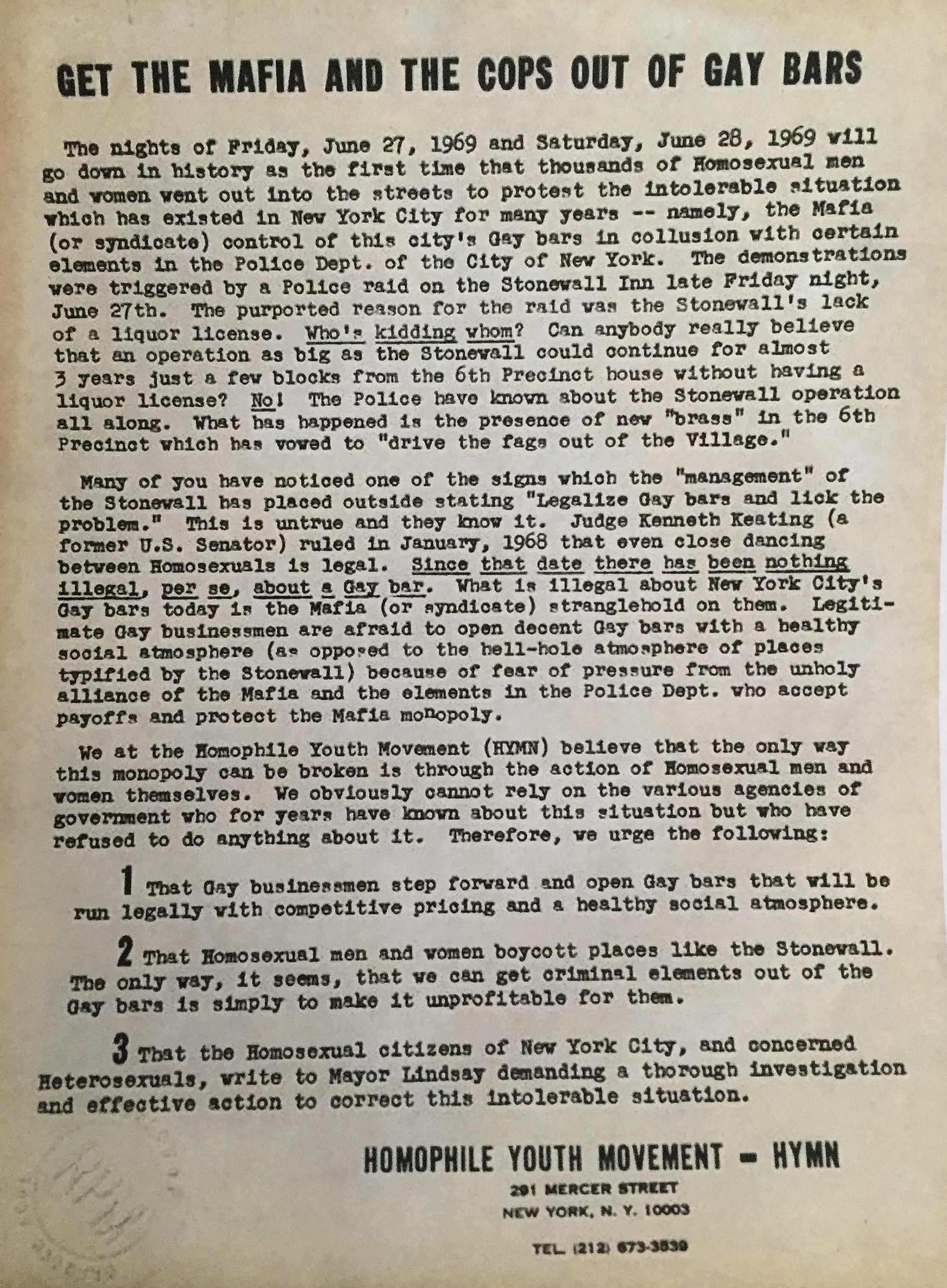
Sargeant advocated that the LGBTQIA+ community needed to open their own bars legally despite city restrictions, boycotting establishments like Stonewall. With Rodwell, Sergeant proposed an annual demonstration for the riots at the Eastern Regional Conference of Homophile Organizations.
Despite his role during Stonewall, Sargent is transgender-exclusionary. He openly advocates for Drop the T campaigns and argues that transgender individuals “did nothing” towards LGBTQIA+ activism. Although figures like Marsha P. Johnson, Sylvia Rivera, Miss Major, and Nova did not identify as transgender during the riots, they would have in modern language. It is theorized that many of Stonewall’s veterans did not identify with medicalized terms like transsexual because they were trying to survive New York City sex work, which was safer to do while identifying as queer and cisgender.


Jack Nichols: From Mattachine Picket Lines to Radical Liberation
Nichols was not present during the Stonewall riots, but he is noted for his reporting. Nichols and his partner, Lige Clarke, were the first journalists to report on the riots to the general public outside of New York City, largely due to his proximity to the riots while working out of Manhattan.
Nichols co-founded the Mattachine Society of Washington with Frank Kameny in 1961, regularly participating in the Mattachine Annual Reminder pickets at Independence Hall. On the opposite side of the Stonewall-Homophile schism, Nichols worked with the Mattachine Society to successfully lobby the American Psychiatric Association into declassifying homosexuality as a mental illness.
Lige Clarke: The Revolutionary Journalist of the Post-Stonewall Press
Like Nichols, Clarke was not physically present during the Stonewall riots. With Nichols, Clarke published eyewitness accounts of the riots to reframe the events as the start of a new revolution.
Clarke and Nichols worked for Screw magazine, although the two would later become the main editors of Gay – the first national weekly LGBTQIA+ newspaper by the end of the Stonewall riots.
Allen Ginsberg: From the Beat Generation to the Stonewall Rebellion
Beat poet Allen Ginsberg visited Stonewall during the third day of rioting. Like many influential Beat poets, Ginsberg lived in Greenwich Village and had heard news about the rebellion. However, Ginsberg was not an active participant in the riots.
Ginsberg had been openly queer since the publication (and lawsuit) of his poem “Howl.” He was encouraged by the riots, stating, “Gay power. Isn’t that great! We’re one of the largest minorities in the country… It’s about time we did something to assert ourselves.”
In the years after Stonewall, Ginsberg became actively involved in political causes like the United States’ involvement in Asia, the Vietnam War, recreational drugs, and communism.
Mark Segal: From Stonewall Rebel to Prime-Time Television “Zapper”
Segal participated in the Stonewall riots, most known for writing on the sidewalks and walls throughout Christopher Street, “Tomorrow Night Stonewall.” After the events of the first night, Segal’s message spread quickly to prepare the community for future riots.
Segal was a founding member of the Gay Liberation Front and Gay Youth, and he worked with Rodwell and Sargent to organize the first Pride parade in 1970. After Stonewall, Segal became particularly fond of direct actions like zaps, which he popularized after crashing a broadcast of WPVI-TV.


Martha Shelley: The Strategic Force Behind the Post-Riot Mobilization
Shelley originally dismissed the Stonewall riots when she passed by, believing the unrest was related to ongoing anti-war demonstrations. When Shelley realized the riots were frustrations related to LGBTQIA+ inequality, she joined in.
Shelley had been a regular member of the Daughters of Bilitis despite her frustration that events like the Annual Reminder were ineffective. The Stonewall riots gave Shelley the perfect opportunity to form the community’s raw anger into long-term organizing.
Despite her important role in LGBTQIA+ organizing, Shelley is a complicated figure. She identifies today as a gender-critical radical feminist (transgender-exclusionary radical feminist, or TERF) and opposes conventional gender-affirming care like hormone replacement therapy. Shelley vocalizes the radical lesbian feminist belief that transgender activism is forcing butch lesbians to become transgender men.
Marty Robinson: Engineering the Political Might of Gay Liberation
Robinson was a provocative activist who participated in the Stonewall riots with Segal and Shelley. With Shelley, Robinson made speeches to the crowds on the second night to move them to action.
Robinson was frustrated with the results obtained from the Mattachine Society, joining the Gay Liberation Front and similar organizations like the Gay Activists Alliance and ACT UP. Like Shelley and Segal, Robinson is credited with creating the theatrical direct action known as “zaps” to interrupt interviews and speeches.
Jerry Hoose: The Christopher Street Youth Who Fought for Total Freedom
Hoose had been living on Christopher Street with other gay homeless youth, joining the Stonewall riots with the crowd. Afterwards, Hoose began organizing with the Gay Liberation Front to create a “society so that gays, lesbians, and transvestites could be free to be themselves.”
Hoose was less focused on political organizing under GLF, preferring to raise money through community dances he would regularly host.


The First Pride: Christopher Street Liberation Day and the Fight for Trans Inclusion
The first Pride observance was held in 1970, originally named Christopher Street Liberation Day. Although the Gay Liberation Front and the Gay Activists Alliance organized the parade in New York City, (unconnected) demonstrations were organized on the same day in Chicago, San Francisco, and Los Angeles.
These four cities created the tradition that would be expanded into the modern festivals organized today. Each of these cities has an extensive queer history that led them to organize in solidarity, although New York considers itself the “true” original Pride.
New York’s Christopher Street Liberation Day was planned by Sargeant, Rodwell, Shelley, Brenda Howard, and Ellen Broidy. Like GLF, the CSLD organizing committee was politically divided – figures like Broidy and Howard were transgender allies in contrast to Sargeant and Shelley.
Sargeant is known today for his public anti-transgender tirade in 2020, stating that transgender people did not participate at Stonewall or organize following pride celebrations. Sargeant’s argument is frequently weaponized by TERFs seeking to erase transgender people from LGBTQIA+ history.
This is not only frustrating because it is blatantly wrong, but because it is documented that Sargeant and Shelley intentionally excluded and silenced transgender individuals (including Johnson, Rivera, and DeLarverie) while capitalizing on their legacies on Stonewall. The very reason Rivera left GLF and gave her famous “Y’all Better Quiet Down” speech was that members like Sargeant pushed anti-transgender assimilation.
Frequently Asked Questions
Who threw the first brick at Stonewall?
There was no single person who threw the “first brick.” Historians actually debate whether an actual brick was ever thrown during the riots.
The Stonewall legend paints Marsha P. Johnson and Sylvia Rivera as throwing the first bricks. The riots were spontaneous, and although the first brick is a powerful piece of queer folklore, Stonewall veterans agree that the myth downplays the collective organizing behind the gay liberation movement.
When and where did the first Pride march take place?
To honor the Stonewall riots, four cities held separate demonstrations in 1970: New York City, Chicago, Los Angeles, and San Francisco. These four demonstrations are collectively the first Pride marches.
- New York City’s Christopher Street Liberation Day March began on Washington Place and continued for 50 blocks and a “gay-in” at Central Park.
- Chicago organized the Gay Liberation March, starting from Washington Square Park down Michigan Avenue to Water Tower.
- Los Angeles managed to get an official permit for the Christopher Street West Parade, marching from McCadden Place to Hollywood Boulevard for a carnival-style festival.
- San Francisco held a modest Gay Liberation March from Polk Street to the Civic Center, organizing a larger gathering at Golden Gate Park that was raided by the SFPD.
Were transgender people excluded from early Pride celebrations?
Yes. Transgender people were silenced, discouraged, and excluded from participating in early Pride demonstrations. Leadership was predominantly white cisgender gay men and women who kept transgender people from engaging.
Even when transgender people could participate in early Pride demonstrations, they weren’t allowed to speak. Despite being refused, Sylvia Rivera grabbed a microphone to deliver her “Y’all Better Quiet Down” speech to confront a growing movement that excluded transgender people, drag queens, and people of color.
Were transgender people involved in the Stonewall riots?
Yes. It is heavily documented that transgender individuals were on the front lines of the Stonewall riots, including Marsha P. Johnson, Nova, Stormé DeLarverie, and Miss Major.
Transgender exclusionaries try to depict Stonewall’s history as void of transgender participants. This simply isn’t true. Although individuals like Johnson and DeLarverie did not identify as transsexual, it would be a gross miscategorization to portray their identities and gender nonconformity as cisgender expression.
Bibliography & Further Reading
Alwood, Edward. Straight News: Gays, Lesbians, and the News Media. New York: Columbia University Press, 1996.
American Psychiatric Association. “Position Statement on Homosexuality and Civil Rights.” American Journal of Psychiatry 131, no. 4 (1974): 497. Available at American Psychiatric Association Foundation.
Blasius, Mark, and Shane Phelan, eds. We Are Everywhere: A Historical Sourcebook of Gay and Lesbian Politics. New York: Routledge, 1997.
Britannica, T. Editors of Encyclopedia. “Stonewall Riots.” Encyclopedia Britannica, last modified 2026.
Carter, David. Stonewall: The Riots That Sparked the Gay Revolution. New York: St. Martin’s Press, 2004.
Chu, Arthur. “An Interview with Lesbian Stonewall Veteran Stormé DeLarverie.” AfterEllen, 2010.
Crawford, Phillip Jr. The Mafia and the Gays. New York: Over the Cliff Series, 2015.
D’Emilio, John. Sexual Politics, Sexual Communities: The Making of a Homosexual Minority in the United States, 1940–1970. Chicago: University of Chicago Press, 1983.
Drescher, Jack. “Out of DSM: Depathologizing Homosexuality.” Behavioral Sciences 5, no. 4 (2015): 565–575.
Duberman, Martin. Stonewall. New York: Plume, 1994.
Edsall, Nicholas C. Toward Stonewall: Homosexuality and Society in the Modern Western World. Charlottesville: University of Virginia Press, 2003.
Emmerich, Roland, dir. Stonewall. Centropolis Entertainment, 2015. Feature Film.
France, David, dir. The Death and Life of Marsha P. Johnson. Netflix, 2017. Documentary Film.
Guggenheim, David, and Scagliotti, John, dirs. “Stonewall Uprising.” American Experience, season 23, episode 2. PBS, 2011. Documentary Film.
Higginbotham, Evelyn Brooks. Righteous Discontent: The Women’s Movement in the Black Baptist Church, 1880–1920. Cambridge: Harvard University Press, 1993.
History.com Editors. “The Stonewall Riots.” History Channel, last modified 2023.
Library of Congress. “The Stonewall Era: A Resource Guide.” LGBTQIA+ Studies Research Guides, Library of Congress, 2024.
Marcus, Eric, host. Making Gay History. Season 5: “Stonewall 50.” Podcast Audio.
Masters, Jeffrey. “Before Stonewall: The Women’s House of Detention Changed Queer History.” The Advocate, May 9, 2022.
National Public Radio. “The Sound of Pride: Stonewall at 50.” NPR Special Broadcast Series, June 2019.
New York Times. “4 Cops Hurt in ‘Village’ Raid.” June 29, 1969. Available at The New York Times TimesMachine Archive.
Rivera, Sylvia. “Y’all Better Quiet Down.” Speech delivered at the Christopher Street Liberation Day Rally, Washington Square Park, New York City, June 1973. Printed in Street Transvestite Action Revolutionaries: Survival, Revolt, and Queer Antagonist Struggle, 4–7. New York: Untorelli Press, 2012.
Ryan, Hugh. The Women’s House of Detention: A Queer History of a Forgotten Prison. New York: Bold Type Books, 2022.
Stein, Marc, ed. Encyclopedia of Lesbian, Gay, Bisexual, and Transgender History in America. New York: Charles Scribner’s Sons, 2004.
StoryCorps. “Remembering Stonewall.” National Public Radio audio archive, June 2009.
Stryker, Susan. “Transgender History, Homonormativity, and Disciplinarity.” Radical History Review 2008, no. 100 (2008): 145–157.
Stryker, Susan. Transgender History: The Roots of Today’s Revolution. 2nd ed. Berkeley: Seal Press, 2017.
Teal, Donn. The Gay Militants: How Gay Liberation Began in America, 1969-1971. New York: Stein and Day, 1971.
Truscott, Lucian K. IV. “Gay Power Comes to Sheridan Square.” The Village Voice, July 3, 1969.
U.S. President. Executive Order 10450. “Security Requirements for Government Employment.” Federal Register 18, no. 82 (April 29, 1953): 2489–2492. Available at National Archives.