
Tag: Point of Pride

  • A Beginner’s Guide to Binders

    A Beginner’s Guide to Binders

    Binding, or the practice of compressing one’s chest to have a flatter and traditionally masculine appearance, is a pretty standard practice amongst the trans community, similar to packing and tucking. Anyone can bind – even if you’re not transgender, there might be moments when it’s beneficial, like if you’re cisgender but engage in cosplay or drag.

    In the transmasculine community, binding is one of the first steps in transitioning. Being assigned female at birth, breast tissue naturally forms during natal puberty and creates distress from gender dysphoria unless preventative measures are taken, like puberty blockers. When trans men begin testosterone through prescribed hormone replacement therapy, breast tissue no longer forms – but HRT cannot reverse tissue already created.* Since few transgender people have the fortune to have supportive parents and the ability to access puberty blockers as youth, binding is the norm.

    *Technically, testosterone-based hormone replacement therapy CAN impact breast tissue, but it cannot get rid of it entirely. It’s all extremely anecdotal, but you might experience breast tissue shrink in size. More commonly, HRT affects the composition of breast tissue and makes it less firm, similar to breast tissue cisgender men have. However, these changes are rarely enough to override the need for binding.

    Q: DO I HAVE TO BIND?
    A: Nope! While binding is common, it is not a requirement to be transgender, and there are many reasons transmasculine folks may choose not to bind, such as having a chest too large for traditional binders, disability, or comfort. Generally, you should talk with your doctor before binding if you have asthma, scoliosis, lupus, COPD, arthritis, Hypermobility Joint Disorder, GERD/IBS/IBD, migraines, TMJD, or fibromyalgia.

    Q: HOW OLD DO I HAVE TO BE TO BIND?
    A: Anyone who has breast tissue is old enough to bind
    , although this statement might make people queasy. American youth are entering puberty earlier than ever, so it’s reasonable to say that if breast tissue is causing them significant discomfort, they should have access to binding. While binding can have long-term consequences, preventing kids from binding safely will only make them more likely to DIY, which can be dangerous. On the other end of the spectrum, there’s no upper age cap for binding.

    Q: WAIT, DID YOU SAY THERE ARE LONG-TERM CONSEQUENCES TO BINDING?
    A: Yes, but those consequences come with caveats.
    Long-term binding can impact the density of your breast tissue, which can potentially limit your options for chest surgery later. However, these effects (which are common at 10+ years of binding) do not bar you from chest surgery – and it’s worth stating that the average transmasculine person gets chest surgery way before this deadline.

    There are plenty of anti-trans parents who will rant on how chest binding will impact children’s bone development during puberty, so youth shouldn’t be allowed to bind. While it is a possibility, there isn’t research to back up this claim: there is little long-term research on transgender people as a whole, and even less on minors. Chest binding, when done safely, isn’t dangerous – a binder should feel like a relatively tight hug and should never cause pain. You should also never wear two or more binders, since the added compression can cause a lot of pain. Exceeding safety recommendations puts you at actual risk of developing skeletal issues, and as mentioned above, barring safe binders from youth pushes them to resort to DIY methods with higher risk.


    Always get the right size.

    Yes, a smaller binder will give you a flatter chest – but the right size vastly minimizes your risk of common side effects. Keep in mind that cisgender men don’t have completely flat chests, and everyone has some breast tissue. Don’t strive for a perfectly flat chest.

    DON’T KNOW YOUR BINDER SIZE? FOLLOW THESE STEPS.

    1. Wrap a tape measure around the fullest part of your chest. This is the part that comes out the farthest from your body. Do this while you are dressed.
    2. Write down the measurement. You might want to measure more than once to check it.
    3. Wrap the tape measure around your chest, right under your breasts. This is where the crease is.
    4. Write down the measurement.
    5. Add the measurements together and divide by 2. This is your chest size.
    6. Put the end of the tape at the outside edge of one of your shoulders. Measure across your body to the outside edge of your other shoulder. Make sure you are standing up straight. Avoid tensing up, hunching your shoulders, or wrapping the measuring tape around your shoulders.
    7. Write down the number you get. This is your shoulder size.


    If your shoulder measurement is 1.5 inches bigger than the shoulder measurements listed for your chest size… Buy a larger size, usually the next size up.

    If your shoulder measurement is smaller than the shoulder measurements for your chest size… Buy the size that matches your chest measurement.

    If you have a larger chest or broad shoulders… Consider a tank binder. This might be the most comfortable style for you.

    If you buy a binder that is smaller than your measurements… Return it for one that fits. The effect on your chest is probably not enough to notice, and the wrong size puts pressure on your back and ribs.

    Wearing the correct binder size MATTERS. Over time, using the incorrect size can restrict breathing, irritate the skin, break skin around the edges of the binder, cause overheating, and bruise/fracture the ribs.

    TYPES OF BINDERS

    Full-Length Tank
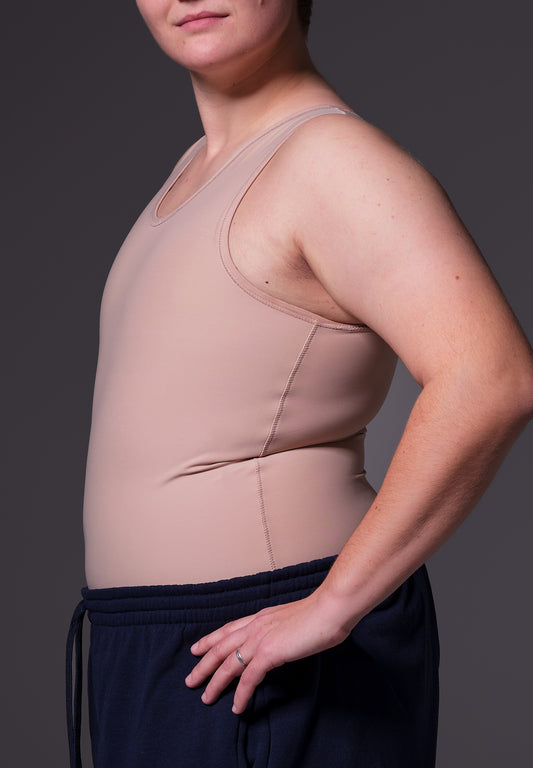
    As one of the two main classics, the full-length or tank binder has a long panel of compression and can be tucked into your pants. They compress more than just the chest – they also flatten the hips and stomach, which is why these are the most common binders used by cisgender men.

    Full-lengths are best suited for individuals with large chests or folks who want additional compression around the stomach and hips. Newer tank binders are made to look like casual shirts, which is a benefit you won’t find with other binder styles. On the other hand, I’ve been told that the more a binder resembles a regular tank top, the less compression it offers. They’re also far less comfortable – from personal experience, full-tanks are hotter and irritating to wear, and I was never able to get the hang of tucking them in, so it would always roll back up.
    Half-Length
    The other classic binder is the half-length, which is identical to the full-length, other than the lack of material. These stop above the ribs, so they’re cooler and allow for a greater range of motion.

    Half-lengths are ideal for individuals with smaller chests compared to full-length, but they can work for folks with larger chests if you’re okay with less compression. They offer better breathability, so they’re more comfortable for all-day use and sports. On the other hand, half-lengths are the most well-known – people will know you’re wearing a chest binder unless you cover it up with a shirt.

    Racerback
    The racerback binder came into style within the last decade, offering even more range of motion than the half-tank. They’re identical to the traditional half-tank other than the back support design resembling the same ‘x’ pattern that racerback sports bras use. The same pros and cons apply to these as half-tanks, but their strap design is easier to conceal for folks who don’t want to possibly out themselves for wearing a binder.

    Strapless
    Strapless binders are the most commonly portrayed in film when depicting transmasculine characters, but they’re far from the most commonly worn by actual transgender people.

    These are often the cheapest since they’re made in mass production for cosplay, but they offer significantly less compression and support than other binder styles. You have to be precise with strapless measurements, too, since the wrong size could mean the binder falling off. These are also difficult to find by major binder brands due to their association.

    I’ll also note that strapless binders like these are considered less safe than other styles – they’re created for cosplay purposes and worn for a day or two at a time, not regular long-term binding. They’re easy to access, but always use with caution.

    Pullover & Zipper
    These aren’t binder styles themselves, but refer to another aspect of all of the above types. A pullover binder will be pulled over your head, similar to a t-shirt, whereas a zipper binder uses a zipper, clasps, or hooks to put the binder around your chest.
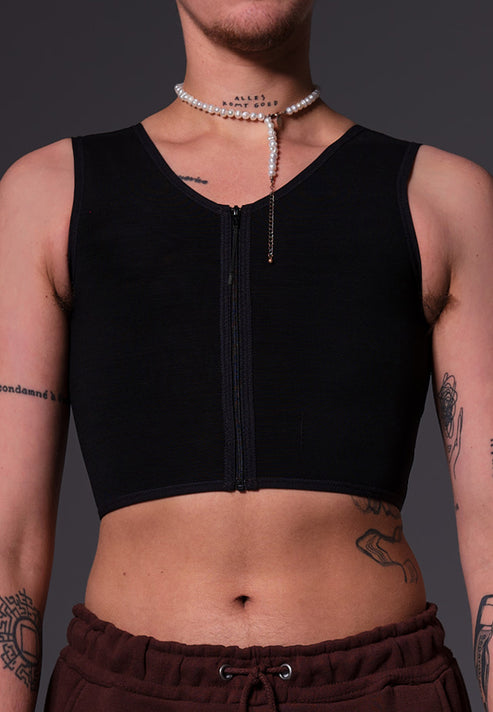
    Both are good options! Pullover binders are more commonly produced by binder brands since they’re associated with better compression, but they’re difficult to put on in the beginning when you’re new to binding. Zipper binders are common for strapless and cosplay binders, but they’re a better option if you struggle to get pullovers on. However, always opt for zipper binders that attach in the center of your chest or back – zipper binders that attach on just one side will cause uneven compression that can harm your body over time.

    Kinetic Tape
    Kinesiology tape, or K-tape, is a thin elastic tape that uses adhesive, and it’s become fairly popular for binding amongst smaller chested individuals. You should NEVER use other forms of tape to bind, such as duct tape, since K-tape is made specifically for athletic purposes and provides a range of motion and breathability that other tape does not. Duct tape is especially dangerous since it constricts your breathing after application.

    K-tape struggles to provide the same level of binding as traditional binders, but many folks find it empowering since it gives a more natural look compared to binders. You can even safely sleep and shower with it since the tape is relatively waterproof and takes a few days to naturally lose its grip.

    If you have the funds, there are a number of K-tapes now produced with chest binding in mind – like Trans Tape. While the function is the same, I’ve heard that the quality of Trans Tape is significantly better, BUT regular K-tape is pretty accessible since anyone can purchase it in their local Walmart.

    Despite this, kinetic tape isn’t for everyone. The compression level isn’t feasible for many, but more often, it’s the adhesive.  Kinetic tapes, regardless of brand, can cause significant irritation to the skin even if you don’t have any adhesive allergies. Later on, I’ll be talking about the importance of binder hygiene, and the same applies here. K-tape is used in a sweaty and hot part of the body that creates a LOT of friction. While I was pleased with the compression K-tape provided me, the tape chafed me pretty badly, and I *don’t* have any adhesive allergies.

    Sports Bra
    A good sports bra can provide a decent level of compression, so it’s a great alternative to regular binding to give your body breaks. In essence, sports bras are similar to racerback binders. Unlike binders, you can find sports bras sold pretty much anywhere, so they’re more accessible.

    Unlike the above binding options, sports bras are the ONLY style that I would okay “double-binding.” Since sports bras offer less compression than actual binders, the compression level achieved from double-layering won’t cause significant harm, like if you layered traditional binders.


    Keep it clean!

    Binders are underwear. Seriously, they can get gross – they’re directly compressing your body and creating hot and humid spaces. Regardless of season, binders should be washed at least weekly, but you should move to every three days if it’s summer or you’re a naturally sweaty person. Even if the binder doesn’t smell too bad, poor binder hygiene causes rashes, skin irritation, acne, fungal infections, and other conditions.

    Each binder manufacturer will provide specific instructions on how to best care for your binder. Follow their advice to prolong the life of your binder! However, if you lost the instructions, these are the most common suggestions.

    • Wash your binder in cold water on a delicate cycle, OR wash it by hand in the sink with laundry detergent and warm water. Avoid hot water and putting your binder in the dryer.
    • Hang the binder up to dry.
    • Keep your binder on a hanger when you are not wearing it. This helps it keep its shape.
    • Have more than one binder, if possible. This allows you to wash and dry them regularly.

    Stay flexible and give your body breaks.

    Listen to your body – what works for your friend won’t inherently work for you. The following are general guidelines, but always listen to your own body first. If you’re in pain, stop.

    • Keep binding for eight hours at a time and never bind more than twelve consecutive hours. This can be difficult to navigate if you’re in public often, but it’s best practice to have off days when you do not bind.
    • Take at least one day completely free of binding per week, and take more break days if you can manage.
    • Never sleep in your binder. Breathing becomes more shallow while you’re unconscious, so binding while asleep poses an increased risk.
    • Take precautions if binding while working out or swimming. There are binders available to purchase to use while swimming, since chlorine exposure can shorten traditional binders’ lifespans, and exercise binders that provide greater mobility. If these aren’t options for you, your dedicated workout or swimming binder should be at least one size larger than what you typically wear.
    • Stay hydrated and keep cool when binding, especially during summer months. Even if you feel fine, it’s pretty easy to develop heat stroke – from personal experience, I got heat exhaustion once while on a summer field trip because I thought it was a myth.
    • Never use any material to bind that was not listed here. Do not use duct tape, plastic wrap, belts, or ACE bandages. These constrict as you breathe, which can bruise you or potentially suffocate you.
    • Consider wearing a cotton undershirt or tank top under your binder if your skin is prone to irritation. Binders won’t help any existing skin conditions. An undershirt or the use of body powder also helps during warm weather to limit excess sweating.
    • Learn exercises and stretches to ease pain in your back, shoulders, and chest. Try stretching every few hours while binding.

    Looking for binder suggestions?

    The following prices are based on the current price at the time this article was published. Verify with the merchant before buying.

    Wait! I want a new binder, but there are too many options!
    Yeah, and there are plenty of binder brands that I don’t cover below – if you hear good things about a binder company from friends or those you trust, go for it and don’t let my lack of review stop you. Otherwise…

    • Generally overwhelmed and just need a good quality binder? Get GC2B.
    • Unable to find a binder size that fits? Get Origami Customs.
    • Have severe dysphoria and need high compression? Get Underworks.
    • Looking for something special to be proud of? Get ShapeShifters.
    • Can’t deal with sensory overload? Get GenderBender or Amor Sensory.

    GC2B @ gc2b.co / $42 USD
    Founded in 2015 as a trans-operated binding brand, GC2B is the premier binder today. After using an Underworks binder, I found GC2B much more comfortable in comparison – although it provided slightly less compression. There’s talk that GC2B binders have gone downhill in quality after they changed textile suppliers, but I’m still a strong supporter of the brand as a whole.

    GC2B has a bit of everything, including K-tape. They specialize in everyday binders, so you’ll find a variety of nude binders designed to be concealed under shirts. Before GC2B, binders were only available in white, black, and a limited number of “nude” binders – but the binder color matters significantly if you’re wanting to wear a white shirt. Their binder utilizes both the front and back panels to provide medium compression.

    FLAVNT @ flavnt.com / $55 USD
    This streetwear brand has a larger range of nude binders than GC2B and has a pretty good selection of pride apparel. Their binders are all pullover style and offer medium compression via the front panel. Tired of hideous rainbow merch from retailers like Target and Walmart? Try FLAVNT.

    For Them @ forthem.com / $55-$64 USD
    This brand specializes in underwear, including binders. For Them produces two types, one labeled “MAX” to offer high compression and “All-Day” that prioritizes comfort.

    The MAX binder will provide compression similar to other brands, but the All-Day line is unique: it’s made with sensory issues in mind. It won’t make you as flat as other binders, but it’s super comfortable.

    Peecock Products @ peecockproducts.com / $31-$34 USD
    Based out of Singapore, Peecock has been producing chest binders since 2010 and also has one of the best quality of entry-level prosthetic packers out there. Zippers, pullovers, v-necks, swimming binders, you name it – Peecock probably has what you’re looking for. However, their binders won’t be as comfortable or sensory-friendly as GC2B.

    TomboyX  @ tomboyx.com / $49 USD
    Although TomboyX caters to femme-identified people, they have a decent binder selection since a large chunk of their customer base is butch. Their selling point is their adjustable binder, which uses straps to allow the user to modify the level of compression. On the other hand, TomboyX binders have lighter compression compared to other brands.

    UNTAG @ untag.com / $61-$69 USD
    Preferred by folks living overseas, UNTAG has a diverse binder selection that offers lower shipping rates compared to some American brands. In addition to the regular selection of binders, UNTAG also offers binders specifically made to exercise and unique designs like lace.

    Urbody @ urbody.co / $45-$55 USD
    These binders were created to further expand binding beyond masculine-identified folks, so they generally offer less compression than other binders. Despite that, Urbody binders are preferred with folks with compression or sensory issues since the lack of compression means increased comfort.

    Underworks @ underworks.com / $32-$38 USD
    As the oldest brand on this list, Underworks is a classic alongside T-Kingdom – they’ve been around since 1997. Originally, their target audience was cisgender men who wanted to compress their torsos, but they transitioned to make an array of trans-friendly binders since Underworks was the easiest place to purchase online.

    If you’re looking for high compression, Underworks is for you. Seriously, their compression is INTENSE – but this means their binders can also be uncomfortable. The material is also rougher than brands like GC2B and Origami.

    GenderBender @ genderbenderllc.com / $49-$59 USD
    These guys are relatively new, but they have a great selection that makes them distinct from other brands, like their own brand of K-tape, pride-themed binders, and plus-sized binding swimwear. Their company is disability-centered, so their products are made with various disabilities in mind, like sensory issues, anxiety, adhesive allergies, and the like.

    Origami Customs @ origamicustoms.com / $64 USD
    In addition to the regular selection of binders, Origami Customs is unique because they can and will make custom binders on order. If you are too large for other binder companies, Origami Customs should be your go-to. Without them, people would be barred from binding due to weight or breast size – but Origami Customs can provide anyone with a binder.

    Origami Customs also has ready-to-order binders, but I wouldn’t really recommend them if you don’t require a custom size.

    Shapeshifters @ shapeshifters.co / $85-$115 USD
    Most binders are boring since they cater to everyday wear and stealth. Not Shapeshifters binders – they don’t actually have any nude binders unless you’re ordering from their “Make Your Own Binder” sewing kit. Shapeshifters specialize in fashionable designs, offering a refreshing alternative to bland options and asking, ‘Why can’t binders be fun too?!’

    However, Shapeshifters is pricier than other brands, so I wouldn’t recommend them as your first binder unless you have money to burn.

    Amor Sensory @ amorsensory.com / $79 USD
    Similar to GenderBender, Amor Sensory is a disability-first binder brand that centers on Autistic experiences. Binding can be a sensory nightmare, so Amor’s binders are sewn with those issues in mind. Even though they cost a bit more, Amor Sensory binders offer trustworthy moderate compression like mainstream brands.

    Reddit and Online Spaces @ r/ftm / FREE to ∞
    If you don’t mind used binders, check out virtual spaces like r/ftm – they host recurring spaces to allow guys to buy, sell, and trade items and you’ll likely find a used or free binder faster than the binder programs I suggest below. You can find these types of spaces on any forum, including Facebook groups and trans-related Discord servers.


    I can’t afford a binder, what should I do?

    Fret not, because there’s still options out there! Before continuing with my suggestions, read my last point on binder brands – in my experience, you’ll get a binder faster from online spaces like r/ftm when there’s availability. The companies and organizations I list below give binders as donations, which means they have limited resources and funding and MASSIVE waitlists.

    Generally speaking, the larger the organization, the longer the waitlist. My very first binder was a donation from Point of Pride, but I had to wait nine months on their waitlist before it was shipped. These resources are national, but if possible, you should check with any local LGBTQIA+ organization in your area to see if they have a binder program. CenterLink hosts a (incomplete) directory of LGBTQIA+ nonprofits throughout the country, so start there if you don’t know where to begin.

    Keep in mind that the following programs are active at the time this article was published. In my experience, binder programs tend to be unstable since they rely on donation funding – so some might be no longer active by the time you’re reading, or there might some missing that you expected to see.

    Point of Pride @ pointofpride.org
    With a variety of funds, Point of Pride has given nearly $4 million dollars to financial aid programs to benefit transgender folks.

    They were created in 2016 by Point 5cc, a trans clothing and apparel company to become the first and largest international chest binder donation program. Check out their website for details on their binder program, femme shapewear and gaff program, electrolysis support fund, HRT access fund, trans surgery fund, and Thrive fund. Their binder program is open to all, regardless of age or where they live in the world.

    Trans Essentials @ ftmessentials.com
    Similar to Transguy Supply, Trans Essentials is an online megastore for trans needs. They sell binders, tucking tape, packers, gaffs, dilators, STPs, books, buttons, etc. They also operate Early to Bed for adult goods.

    TE provides free Underworks binders to individuals ages 24 and under anywhere in the United States, shipped out on a quarterly basis.

    TOMSCOUT @ tomscout.com
    The Freedom Binder Program provides binders to “storytellers,” determining eligibility based on your personal story and need for a binder.

    Make sure to read all of TOMSCOUT’s rules before applying, since missing one will automatically disqualify you. There is no upper age cap, but applicants must be at least sixteen to qualify. Additionally, you’ll have to cover the shipping costs of the binder once you’ve been selected.

    The Queer Trans Project @ queertransproject.org
    Based out of Florida, QTP is a Black-led organization that donates binders, packers, and packing underwear to individuals in need.

    QTP has high demand, but they cover a lot of needs – including flight assistance to help transgender folks flee hostile states like Florida for safer havens.

    Black Trans Men Inc @ blacktransmen.org
    The Brother 2 Brother Binder Grant allows Black Trans Men Inc to give free binders to low-income transgender men of color throughout the US.

    To qualify, you must be at least sixteen years old, identify as transmasculine, demonstrate financial hardship, and identify as Black. There are no upper age cut-offs for their program. If you don’t identify as Black, they can still help if you reach out by referring you to other applicable programs.

    Health Care Advocates International @ hcaillc.com
    Healthcare access isn’t equal to everyone, which is something marginalized people know well. HACI believes every patient deserves their best chance at a health life.

    You must be at least eighteen years olds to qualify for HACI binders. Individuals must be in the United States or Puerto Rico to receive a binder from their services.

    Thriving Transmen of Color @ thrivingtransmenofcolor.org
    TTMOC is a national grassroot nonprofit with chapters in Virginia, Georgia, District of Columbia, California, Florida, Illinois, and Nevada. Like Black Trans Men Inc, TTMOC centers on uplifting Black and Brown transgender individuals.

    TTMOC binders are provided based on eligibility and are reserved only for transmasculine individuals who cannot afford to purchase their own binder. Applicants must be following TTMOC on social media and have attended at least one virtual or in-person event to qualify.

    Phoenix Transition Program @ phoenixtransitionprogram.org
    PTP offers direct assistance to transgender folks in need, such as their binder program, care packages, utilities assistance, opening businesses, and crises.

    To qualify, you must be at least eighteen years old and live in the United States. Other programs beyond binder assistance are functioning, but are limited based on time of year.


    Additional Resources

    Looking for more educational guides?

    Browse Trans Solidarity Project’s guides, or check out these posts:

  • The Basics of Gender-Affirming Surgery

    The Basics of Gender-Affirming Surgery

    Surgery can be an important step in the journeys of many transgender people in their pursuit to live comfortably and authentically as themselves. The ability to get necessary medical care is integral for democracy, and the ability for transgender folks to choose when, how, and why they get gender affirmation surgery is important for bodily autonomy. Learn about the basics of related surgeries in this post.

    Looking for information about HRT or general transgender resources? We have plenty of trans-specific guides, ranging from binding to legal information.

    DISCLAIMER: It is still common for people to believe transgender people must get “the surgery” or at least be actively pursuing it. There are even people who believe you must get “the surgery” before identifying as transgender – while “the surgery” usually refers to bottom surgery, also known as genital surgery or sex reassignment surgery, these notions are both false. Surgery is a personal choice, and there are many reasons why a transgender person may want or not want a procedure – it doesn’t make them less transgender.


    Glossary

    The following are frequently used terms that will help guide your understanding of this article. It isn’t comprehensive, but it’s a great starting point.

    GENDER AFFIRMATION SURGERY

    The most modern term for any surgery done to affirm the gender of a transgender person – which includes all of the surgeries in this article. There is no single surgery all transgender people seek to get, which is why “gender affirmation surgery,” or GAS, fits in today’s language. Other terms include gender confirmation surgery, gender reassignment surgery, and sex reassignment surgery – while they have different connotations, they generally mean the same thing.

    The only term not advised to use is “sex change.” This term is usually considered offensive due to its negative connotation and usage.

    PRE-OP/POST-OP/NON-OP

    These terms are all short-hand and slang used within the transgender community to describe surgery status.

    Pre-op, or pre-operative, refers to a transgender person who seeks a gender affirmation surgery of some sort but has not received it due to a variety of reasons, like medical barriers, cost, physical health, safety, etc.

    Post-op, or post-operative, refers to a transgender person who sought a gender affirmation surgery and has received it.

    Non-op, or non-operative, refers to a transgender person who does not seek a certain gender affirmation surgery and does not plan to pursue it out of personal choice, rather than the barriers mentioned for pre-op individuals.

    It is possible to be pre-op, post-op, and non-op at the same time – these terms are usually used within the community for specific surgeries as well as surgical status as a whole. Someone can consider post-op for having a chest reconstruction surgery, pre-op for seeking bottom surgery like metoidioplasty, and non-op for not wanting to pursue a procedure like facial surgery.

    MEDICALLY NECESSARY

    This term is often used within healthcare and insurance to describe whether a treatment will be covered by your insurance provider. Medically necessary treatments are services that are deemed as important for diagnosing, treating, or preventing an illness or injury. To qualify as medically necessary, treatment must be regarded as effective for your condition and must be done per generally accepted medical practices.

    At the end of the day, transgender healthcare is considered medically necessary because it’s supported by all major medical institutions and is backed by decades of research proving the positive impact of trans-related treatments. Not all treatment options are considered medically necessary, though, and this article will point out which are and which are not.


    Requirements for Gender-Affirming Surgery

    Any surgeon who performs gender affirmation surgeries should follow the standards of care guidelines by the World Professional Association for Transgender Health (WPATH), which has produced these standards based on best healthcare practices since its founding in 1979. For historical context, WPATH was originally known as the Harry Benjamin International Gender Dysphoria Association – named after Harry Benjamin, who worked with Magnus Hirschfeld to provide healthcare to transgender and queer folks in pre-Nazi Germany.

    WPATH has recently gotten negative media attention, sparked by the executive order by President Donald Trump “Protecting Children from Chemical and Surgical Mutilation.” The order, fueled by Project 2025, falsely accuses WPATH of being “junk science” despite decades of peer-reviewed research and being internationally agreed as the best treatment standard for gender dysphoria. Ordering all government agencies to rescind any policies that use WPATH, Trump and Project 2025 use actual junk science to fuel their anti-transgender claims.

    The 8th edition of the Standards of Care was released in 2022, and research and guidelines on surgery are detailed in Chapter 13.

    “In appropriately selected TGD individuals, the current literature supports the benefits of GAS. While complications following GAS occur, many are either minor or can be treated with local care on an outpatient basis. In addition, complication rates are consistent with those of similar procedures performed for different diagnoses (i.e., non-gender-affirming procedures)… The efficacy of top surgery has been demonstrated in multiple domains, including a consistent and direct increase in health-related quality of life, a significant decrease in gender dysphoria, and a consistent increase in satisfaction with body and appearance. Additionally, rates of regret remain very low, varying from 0 to 4%… Although different assessment measurements were used, the results from all studies consistently reported both a high level of patient satisfaction (78–100%) as well as satisfaction with sexual function (75–100%). This was especially evident when using more recent surgical techniques. Gender-affirming vaginoplasty was also associated with a low rate of complications and a low incidence of regret (0–8%).”

    Standards of Care Version 8, WPATH on the effectiveness of gender-affirming surgery.

    “If written documentation or a letter is required to recommend gender affirming medical and surgical treatment (GAMST), only one letter of assessment from a health care professional who has competencies in the assessment of transgender and gender diverse people is needed…

    Criteria for Surgery:
    a. Gender incongruence is marked and sustained;
    b. Meets diagnostic criteria for gender incongruence prior to gender-affirming surgical intervention in regions where a diagnosis is necessary to access health care;
    c. Demonstrates capacity to consent for the specific gender-affirming surgical intervention;
    d. Understands the effect of gender-affirming surgical intervention on reproduction and they have explored reproductive options;
    e. Other possible causes of apparent gender incongruence have been identified and excluded;
    f. Mental health and physical conditions that could negatively impact the outcome of gender-affirming surgical intervention have been assessed, with risks and benefits have been discussed;
    g. Stable on their gender affirming hormonal treatment regime (which may include at least 6 months of hormone treatment or a longer period if required to achieve the desired surgical result, unless hormone therapy is either not desired or is medically contraindicated).”

    Standards of Care Version 8, WPATH summary requirements for adult surgery.

    There are two main takeaways from WPATH’s standards on surgery: the main qualifier to be eligible for gender affirmation surgery and have it be considered medically necessary is identifying with having gender dysphoria for a substantial length of time – usually between six to twelve months; most additional requirements like letters and use of hormone replacement therapy are optional.

    Just like I explained regarding HRT, you are not going to find a licensed provider that would be willing to operate on someone who just suddenly ‘decided’ they are transgender – they must firmly believe that you understand the gravity of gender-affirming surgery, that you can fully consent to the procedure, and you are aware of its potential benefits and risks. Any media outlet or online personality that states otherwise is purposely lying to garner attention. While letters are not necessarily required according to WPATH guidelines, written documentation from a healthcare professional or mental health provider establishes the first requirement under WPATH – it gives proof to both your prospective surgeon and insurance company that you have experienced gender dysphoria for a set amount of time.

    A decade ago, it was common for surgeons to require additional hoops for transgender people to access gender-affirmation surgery. Most often, surgeons required their prospective patients to have written documentation proving they had been on hormone replacement therapy for up to three years before they would consider them eligible for surgery. These HRT requirements weren’t usually pushed by insurance providers but existed as an additional safeguard for surgeons to lengthen the process of care – but it also served as a method of gatekeeping. Hormone replacement therapy is still a requirement for select surgeries where the effects of HRT have a direct positive impact on the result of a surgery, like testosterone and metoidioplasty. Other surgeries, like vaginoplasty or phalloplasty, may require electrolysis or laser hair removal. Going back further in time, surgeons also commonly required patients to have “real-life experience,” or proof that they were living as their chosen gender “full-time” – these requirements disproportionally barred individuals who were unable to transition out of safety, which is why they fell out of favor, although today’s societal acceptance of transgender people means more folks can live as themselves before surgery.

    These requirements are not the same as those placed on transgender minors – WPATH has different guidelines for youth procedures:

    “Criteria for Surgery:
    – A comprehensive biopsychosocial assessment including relevant mental health and medical professionals;
    – Involvement of parent(s)/guardian(s) in the assessment process, unless their involvement is determined to be harmful to the adolescent or not feasible;
    – If written documentation or a letter is required to recommend gender-affirming medical and surgical
    treatment (GAMST), only one letter of assessment from a member of the multidisciplinary team is
    needed. This letter needs to reflect the assessment and opinion from the team that involves both medical and mental health professionals (MHPs).

    a. Gender diversity/incongruence is marked and sustained over time;
    b. Meets the diagnostic criteria of gender incongruence in situations where a diagnosis is necessary to access health care;
    c. Demonstrates the emotional and cognitive maturity required to provide informed consent/assent for the treatment;
    d. Mental health concerns (if any) that may interfere with diagnostic clarity, capacity to consent, and
    gender-affirming medical treatments have been addressed; sufficiently so that gender-affirming medical treatment can be provided optimally.
    e. Informed of the reproductive effects, including the potential loss of fertility and the available options to preserve fertility;
    f. At least 12 months of gender-affirming hormone therapy or longer, if required, to achieve the
    desired surgical result for gender-affirming procedures, including breast augmentation, orchiectomy, vaginoplasty, hysterectomy, phalloplasty, metoidioplasty, and facial surgery as part of
    gender-affirming treatment unless hormone therapy is either not desired or is medically contraindicated.”
    Standards of Care Version 8, WPATH summary requirements for youth surgery.

    Some of the requirements are the same – but there are important distinctions. WPATH has a longer length for HRT usage than adults, and their standards also dictate the requirements for HRT and puberty blockers in transgender youth. They must have reached Tanner stage 2 of puberty to be eligible for either treatment and have their parents or legal guardians involved in the process. Written documentation has a higher bar set on who can write it for it to be valid for surgery. Youth must also demonstrate emotional and cognitive maturity in addition to proving they fully understand their treatment options. Combined, these standards make surgery incredibly difficult for transgender youth to pursue and push them to wait until after they turn 18, and the requirements lessen. These requirements also firmly debunk false accusations by anti-transgender individuals who claim minors are getting these surgeries en masse – the only surgery trans youth tend to have access to is top surgery or chest reconstruction, which still has all of the above requirements associated with it.


    Financing Gender-Affirming Surgery

    Surgery is expensive – especially in the United States, which makes money one of the primary barriers in whether transgender folks can pursue gender affirmation surgery. The first step towards financing your surgery is to deep-dive into your insurance coverage. Federal law prohibits most commercial and government insurance programs from discriminating against transgender-related care – but it still happens.

    Before continuing, here are some main legal points to keep in mind:

    • Insurance providers cannot place blanket exclusions. Any plan that states something akin to “all care related to gender transition is excluded” violates federal law.
    • Insurance providers cannot place categorical exclusions on specific transition-related treatments deemed medically necessary. Plans that purposely exclude coverage for procedures like facial feminization surgery or voice surgery would violate this part of the law.
    • Insurance providers cannot place discriminatory limits on transition-related care. Any treatment covered for cisgender people must be covered for transgender people, too. For example, plans that cover breast reconstruction for cancer treatment in cisgender women cannot deny transgender people also seeking chest reconstruction for their gender dysphoria.
    • Insurance providers cannot cancel your coverage, refuse to enroll you, or charge you higher rates because of your transgender status.
    • Insurance providers cannot deny coverage because it is typically associated with one gender. If a healthcare professional recommends a procedure that is traditionally gendered, like prostate exams or pap smears, insurance providers cannot deny coverage simply because that individual is listed as the “wrong gender” on their paperwork.

    If you believe you are experiencing discrimination, there are several steps you can take. Firstly, appeal any insurance denials you receive and keep in mind that you should apply for preauthorization before undergoing any procedures to ensure you know your standing regarding coverage. If your appeals do not go through, you may need to talk to an attorney or legal professional – like the National Center for Lesbian Rights, Lambda Legal, the Transgender Law Center, ACLU, or local organizations. You can also report anti-transgender discrimination with the United States Department of Health and Human Services and state agencies – check out Advocates for Trans Equality’s page for more information.

    Confused by the American healthcare system and don’t know where to start with insurance? Click here.

    Public Health Providers

    Medicaid is the largest public insurance provider in the United States, run as a joint federal and state program to provide free medical coverage to low-income Americans based on income. Each state and territory has its own requirements for Medicaid, so you have to look into the specific policies relevant to where you live. In the majority of the country, transgender-related care is covered by Medicaid for adults – either explicitly by state protections or implicitly by the above protections in federal law. However, Trump’s executive order “Protecting Children from Chemical and Surgical Mutilation” currently bans any transgender-related coverage to minors through government programs like Medicaid, Medicare, and TRICARE. This order is being sued in court, but it has not yet been paused by federal courts – until then, the order causes immense harm as it shuts down gender-related care at major hospitals.

    At the time of this article, 10 states ban transgender-related coverage in their Medicaid programs: Idaho, Arizona, Texas, Nebraska, Missouri, Kentucky, Tennessee, Florida, Ohio, and South Carolina. However, as mentioned in this post, it’s worth remembering that not all adults are eligible for Medicaid since 10 states also ban single adults from applying entirely, regardless of income.

    Medicare is a federal program that provides medical coverage to people with disabilities as well as older adults ages 65 and older, regardless of income status. Since it is run federally and not controlled by individual states, Medicare offers less flexibility than programs like Medicaid but is less discriminatory as a whole. Since 2014, Medicare has covered transition-related surgery, and there is no national exclusion for transgender treatments. In practice, Medicare deals with trans-related healthcare the same as it does other forms of coverage – each individual is covered on a case-by-case basis based on whether the care is deemed clinically necessary. Learn more here.

    The US Department of Veterans Affairs provides free healthcare to anyone who has served in the armed forces and did not receive a dishonorable discharge, while active service members are covered by TRICARE until their service is complete. The VA will cover most transgender-related procedures, including hormone replacement therapy, binders, prosthetics, mental health care, and voice coaching – but the VA still prohibits any coverage of transition-related surgery regardless of medical need. Read more about VA coverage here.

    Due to Trump’s executive order “Prioritizing Military Excellence and Readiness,” transgender people are again banned from serving in the United States armed forces. It is unclear whether this ban will dishonorably discharge American servicemembers, similar to the previous Trump ban, but a similar act would bar transgender people from using VA health services despite their service. Since transgender individuals are banned from the military, TRICARE does not offer transition-related services to its active members – although it still currently provides limited treatment coverage to family members of active members as long as they are at least 19 years old.

    All Native Americans recognized by a Federally recognized tribe are eligible for free healthcare coverage through Indian Health Services within their official IHS district or reservation. While IHS provides gender-affirming coverage for treatments within their scope, there is no information about their procedures due to the Trump directive to purge government health websites of data – including transgender issues and other unrelated topics. While the federal courts have ordered the administration to restore the data, this story is still developing.

    Incarcerated individuals are one of the few groups in the United States entitled to healthcare protected as a constitutional right – although there are no standards of what minimum healthcare must be provided for free since it is not codified or elaborated in law. Gender-affirming care, including hormone replacement therapy and surgery, are supposedly protected rights – but most prisons have barriers in place, like requiring proof of care before arrest. These barriers are what cause a quarter of transgender inmates to be denied healthcare, even though accrediting organizations like the National Commission on Correctional Health Care recommend transgender procedures.

    Commercial Providers

    The majority of Americans use commercial insurance through the Healthcare Insurance Marketplace or their employer when they do not meet the criteria for other providers like Medicaid, CHIP, Medicare, IHS, VA, TRICARE, etc. Anyone at least 18 years old and not currently incarcerated is eligible for the Marketplace as long as they are lawfully living in the United States and are not eligible for Medicare – individuals eligible for Medicaid are recommended to use the Marketplace since it also issues coverage for those meeting their state guidelines. Out2Enroll is the best national resource for researching care guidelines – their information is entirely free and user-friendly, and their Trans Health Insurance Guides page has up-to-date data for transgender coverage in each state.

    Only two US states currently permit commercial insurance providers to refuse gender-affirming care: Mississippi and Arkansas. Mississippi’s law only relates to gender-affirming care for minors, whereas Arkansas’ law applies to everyone regardless of age. As mentioned previously, this law directly violates federal law – but it must be successfully sued to be taken down.

    Historically, these laws focus on whether commercial providers are allowed to deny transgender-related care. Zero laws intend to outlaw transitional treatments entirely and prevent providers from opting to cover them – in Arkansas, there are still insurance companies that cover transgender treatments even if they’re ‘allowed’ to deny coverage. While there are entities that seek to outlaw transgender care entirely (ex. Project 2025 and the Heritage Foundation), it’s exceedingly unlikely to take that jump – and if it did, the crisis in the United States would cause an international precedent of allowing transgender Americans to flee as refugees due to the depth of that jump. Instead, it is more likely that anti-transgender organizations and people in power will tear away at American healthcare protections in attempts to federally legalize coverage discrimination rather than outright banning coverage.

    For information about commercial insurance that is not covered by Out2Enroll, check out Advocates for Trans Equality’s Trans Health Project – their site goes in-depth on legal rights regarding commercial coverage and how to navigate its systems.

    Crowdfunding & Grants

    In the age of the internet, crowdfunding is a common route many transgender folks use to finance transgender-related surgeries when their primary insurance provider fails them, or they lack coverage entirely. The most commonly used platforms are GoFundMe, Donorbox, and Facebook – although all of these sites take a percentage of the money raised. GoFundMe is the largest crowdsource site, but it’s known to take the largest cut compared to alternatives. Non-personal organizations and nonprofits have a larger variety of sources out there, like Givebutter, while individuals can raise money without losing a percentage through direct money transfer apps like Cash App, Venmo, Paypal, and Zelle.

    Point of Pride has several programs that provide free funding to transgender folks in need of gender-affirming care like surgery, HRT, electrolysis, chest binders, femme shapewear, and other needs like wigs, prosthetics, fertility preservation, vocal training, etc. They use factors like financial need and Medicaid/healthcare insurance coverage to disperse their funds to a limited number of individuals each year. Other national organizations with similar funds include Genderbands, TransMission, TUFF, Trans Lifeline, Queer Trans Project, Dem Bois, For the Gworls, Black Trans Fund, and the Jim Collins Foundation. Many regional organizations and LGBTQIA+ community centers offer similar funds for people local in their area.

    Credit

    This option is less advised compared to the above routes – if possible, use any insurance coverage you have and work your way down this list. Personal loans through online lenders and credit unions are the best route for borrowing money for gender affirmation surgery, with their own pros and cons. Online personal loans can be used for nearly any purpose, including medical costs, and range up to $100,000 but can be expensive if you don’t pay attention to your monthly payment and annual percentage rate. Credit unions offer similar personal loans at lower interest rates but use your credit score to determine whether you qualify for their funding.

    The most common credit card associated with healthcare costs is CareCredit, which offers zero-interest financing for a designated term. However, the downside to CareCredit is that it defers interest after its promotional period if you fail to finish your payments within that period – and CareCredit’s standard APR is 29.99%. Depending on your credit score, other credit cards offer alternatives with lower interest rates than CareCredit.

    Lastly, some surgeons and healthcare providers offer payment plans similar to credit financing that break up large medical bills into more affordable monthly payments. Make sure you read the terms before signing and negotiate with your provider to understand additional billing fees associated with using a payment plan.


    Common Gender-Affirming Surgeries

    BODY CONTOURING.

    Associated with: Any/All Genders. Set of surgical procedures that uses liposuction, fat grafting, and skin excision techniques to sculpt the body to appear more feminine, masculine, or androgynous. Can be covered as medically necessary on a case-by-case basis with sufficient documentation of gender dysphoria. Recovery time of two to three weeks, average cost of $8,500 to $19,500 without coverage.

    BREAST AUGMENTATION

    Associated with: Transfeminine. Surgical procedure that utilizes breast implants to create a female breast contour, especially when combined with estrogen-based hormone replacement therapy. Can be covered as medically necessary, especially if breast contour from HRT is insufficient to alleviate gender dysphoria. Also known as MTF top surgery. Recovery time of four to eight weeks, average cost of $5,000 to $10,000 without coverage.

    CHEST RECONSTRUCTION

    Associated with: Transmasculine. Surgical procedure that removes the breasts through a variety of techniques to create a male chest. Widely considered medically necessary and is the most common gender-affirming surgery for transmasculine individuals. Also known as FTM top surgery or a mastectomy. Recovery time of six to eight weeks, average cost of $3,500 to $10,000 without coverage.

    ELECTROLYSIS

    Associated with: Transfeminine. Non-surgical technique that permanently removes hair regardless of hair type or skin color but is slower than laser hair removal (which works best for dark hair and light skin and does not work on blonde, gray, white, or red hair). Widely considered medically necessary and commonly covered with prior authorization. Recovery time of two to three weeks per session, average cost of $30 to $150 per session without coverage.

    FACIAL FEMINIZATION

    Associated with: Transfeminine. Surgical procedures that transform traditional male facial features into shapes, sizes, and proportions associated with female features. Considered medically necessary. Also known as FFS. Recovery time of six to twelve months, average cost of $4,500 to $100,000 without coverage.

    FACIAL MASCULINIZATION

    Associated with: Transmasculine. Surgical procedure that masculinizes facial features, especially in individuals who do not receive sufficient masculinization from testosterone through hormone replacement therapy. Can be considered medically necessary with sufficient documentation of gender dysphoria. Also known as FMS. Recovery time of six to twelve months, average cost of $1,000 to $20,000 without coverage.

    HAIR TRANSPLANTS

    Associated with: Any/All Genders. Surgical technique that creates hairlines associated with male or female stereotypes and restores hair loss. Can be deemed medically necessary but not commonly covered by most insurance providers without sufficient documentation for gender dysphoria. Recovery time of ten days per session, average cost of $4,000 to $15,000 without coverage.

    HYSTERECTOMY

    Associated with: Transmasculine. Surgical procedures that remove the uterus or womb. Total hysterectomies remove the cervix, although the removal of the ovaries varies based on patient preference and medical need. The three main procedures include laparoscopic, vaginal, and abdominal – while abdominal is the most common, it is the most invasive and has the most associated complications. Widely considered medically necessary. Also known as masculinizing lower surgery or hysto. Recovery time of six weeks, average cost of $16,000 to $17,000 without coverage.

    LARYNGOCHRONDOPLASTY

    Associated with: Transfeminine. Surgical procedure performed as a type of facial feminization surgery to reduce the size of the Adam’s apple by removing thyroid cartilage. Can be considered medically necessary. Also known as a tracheal shave. Recovery time of two to four weeks, average cost of $3,000 to $10,000 without coverage.

    METOIDIOPLASTY

    Associated with: Transmasculine. Surgical procedure that creates a small phallus from existing genital tissue formed from clitoral enlargement from testosterone-based hormone replacement therapy. Widely considered medically necessary when accompanied by medical documentation. Also known as meta. Recovery time of six weeks, average cost of $4,000 to $60,000 without coverage.

    NULLIFICATION

    Associated with: Nonbinary. Surgical procedure that reroutes the urethra to the perineum to create a gender-neutral appearance to the genitals. Compared to other genital surgeries, gender nullification is relatively new and was introduced as an option due to the growing number of medical professionals well-versed in nonbinary identities. Can be considered medically necessary, although you may have to combat your insurance provider due to it being considered more experimental than other genital surgery options. Also known as nullo or eunuch surgery. Recovery time of six to eight weeks, average cost of $15,000 without coverage.

    OOPHORECTOMY

    Associated with: Transmasculine. Surgical procedure that removes the ovaries, halting the natural production of estrogen. Considered medically necessary and often done alongside hysterectomies. Recovery time of two to six weeks, average cost of $7,000 without coverage.

    ORCHIECTOMY

    Associated with: Transfeminine. Surgical procedure that removes the testicles/testes, halting the natural production of testosterone. Widely considered medically necessary and can be done alongside other gender-affirming genital surgeries. Recovery time of two to four weeks, average cost of $2,000 to $8,000 without coverage.

    PENECTOMY

    Associated with: Transfeminine. Surgical procedure that removes the penis and relocates the urethra to allow the individual to urinate more freely. Considered medically necessary. Recovery time of four weeks, average cost of $8,000 without coverage.

    PHALLOPLASTY

    Associated with: Transmasculine. Surgical procedure that creates a penis using tissue grafted from another part of the body, such as the forearm or hip. Widely considered medically necessary when accompanied by medical documentation. Also known as phallo. Recovery time of twelve weeks, average cost of $25,000 to $50,000 without coverage.

    SCROTOPLASTY

    Associated with: Transmasculine. Surgical procedure that creates a scrotum using skin from the labia and a silicone implant, often done in conjunction with other genital surgeries like metoidioplasty or phalloplasty. Considered medically necessary. Recovery time of eight weeks, average cost of $3,000 to $5,000 without coverage.

    URETHROPLASTY

    Associated with: Transmasculine. Surgical procedure that repairs and lengthens the urethra during gender-affirming genital surgery to allow the individual to urinate while standing using their new anatomy. Widely considered medically necessary. Recovery time of six weeks, average cost varies based on accompanying procedures.

    VAGINECTOMY

    Associated with: Transmasculine. Surgical procedure that removes the vaginal lining and closes the vagina, reducing the complications associated with other genital surgeries like metoidioplasty and phalloplasty. Widely considered medically necessary. Recovery time of six to eight weeks, average cost varies based on accompanying procedures.

    VAGINOPLASTY

    Associated with: Transfeminine. Surgical procedures that transform male genitals into functional and aesthetic vaginas and vulva. Widely considered medically necessary. Recovery time of six to eight weeks, average cost of $20,000 to $30,000 without coverage.

    VOICE SURGERY

    Associated with: Transfeminine. Surgical procedure that alters the voice to better fit traditional male and female stereotypes. While possible for transmasculine and nonbinary individuals, it is more commonly associated with transfeminine transitions since testosterone-based hormone replacement therapy naturally alters the voice, whereas estrogen-based HRT does not. Can be considered medically necessary. Recovery time of six months, average cost of $5,500 to $9,000 without coverage.

    VULVOPLASTY

    Associated with: Transfeminine. Surgical procedure that removes the penis, scrotum, and testicles while also creating a labia, clitoris, and urethral relocation – but unlike vaginoplasty, it does not create a vaginal canal and instead has a zero/shallow-depth dimple constructed. Can be considered medically necessary. Recovery time of six to eight weeks, average cost of $20,500 to $22,000 without coverage.