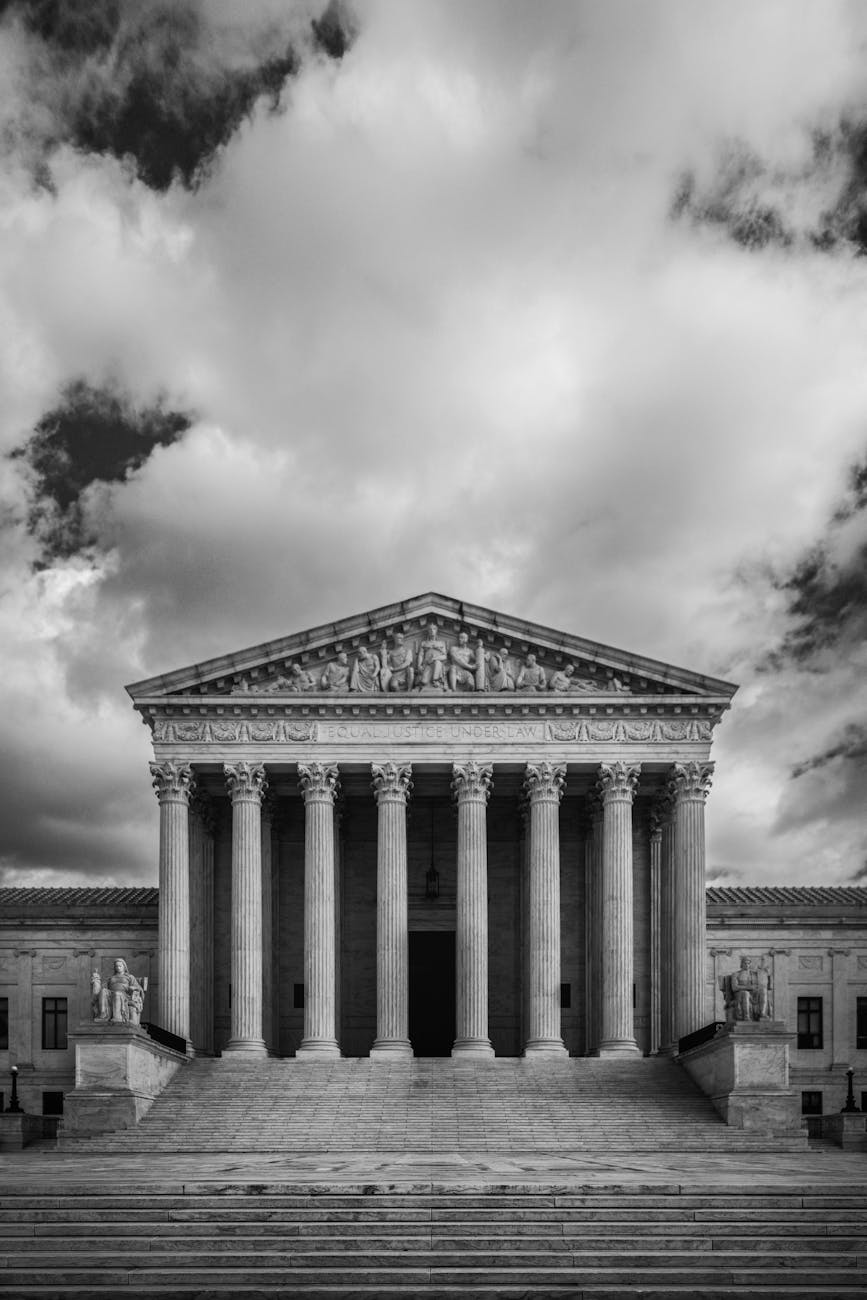
In a devastating update, the United States Supreme Court voted along party lines to uphold Tennessee’s unethical blanket ban on gender-affirming care for transgender minors. United States v. Skrmetti was decided 6-3 and has potentially severe consequences for adult care as well.
Their logic is derived from stating that the current ban on gender-affirming care for minors is based on gender dysphoria and not sex, so it cannot be classified as sex-based discrimination – the same logic used by the Trump administration when removing LGBTQIA+ protections under Title IX. Of course, this logic is flawed: at this moment, the Court views transgender identity as a mental health issue, but they are choosing to ignore that other aspects of Tennessee’s laws (as well as other states across the country) wish to prosecute transgender people for sex crimes based on sex assigned at birth. In her coverage of the topic, Erin Reed wrote, “The Tennessee law, Justice Sotomayor and the dissent argue, explicitly classifies on the basis of sex—so overtly that the majority’s attempt to sidestep that reality reads as disingenuous. The statute itself declares that one purpose of the ban is to ‘encourage minors to appreciate their sex,’ and yet the majority still concludes it does not constitute sex-based classification.” This argument also fails to consider that while gender dysphoria is currently classified as a mental disorder, it is the required diagnosis for medically necessary treatment for transgender individuals. The World Health Organization and other experts on mental and physical health have declassified transgender identity itself as a mental illness since our distress is caused by the dysphoria or disconnect between internal gender and outward expression. As NPR wrote, “[The] Supreme Court decision was a big win for Tennessee and 24 other states, but there are many questions that remain unanswered.”
Permitting states to ban gender-affirming care, the medically necessary and most effective treatment for gender dysphoria, to treat transgender people in distress is as nonsensical and inhumane as banning other medications like insulin for the treatment of diabetes or banning the prescription of albuterol for asthma.
The current ruling is also dangerous, since it seems to permit states to ban transgender healthcare entirely – not just for minors. The conservative Court is not arguing that states have a right to ‘protect children from medical treatments’ like gender-affirming care; they are arguing that states have a right to ban gender-affirming care entirely.
“Today’s Supreme Court decision is a devastating blow to transgender youth and the families who love them, but it will not break our resolve. Families may now have to make the heartbreaking choice to leave their state or split their families, or take on extensive financial burdens, to ensure that their kids can access medically necessary care.
“This Court chose to allow politicians to interfere in medical decisions that should be made by doctors, patients, and families—a cruel betrayal of the children who needed them to stand up for justice when it mattered most.
“As parents, advocates, and community leaders, we know that our fight doesn’t end in courtrooms—it lives in our communities, our hearts, and our unwavering commitment to each other. Still, we will not be deterred. We will support families forced to make impossible choices, fund legal challenges, and build a movement so powerful that no politician can ignore us. Together, we will turn this pain into power and keep fighting until every transgender person in America can live with dignity, safety, and the freedom to be who they are.”
Erin Reed also reported that “Though the majority avoided that outcome, three justices—Justices Samuel Alito, Clarence Thomas, and Amy Coney Barrett—wrote separately to express that they would have gone further, explicitly denying transgender people equal protection under the law.” While the Court’s decision does not affect transgender individuals living in states that protect gender-affirming care, it further divides the country. Gleeful legislators are banning the most effective treatment for transgender people, the most proven deterrent that lowers the suicide rate amongst the trans community – depending on where you live, you may not be able to legally obtain medically necessary healthcare that has been the gold standard throughout the world for decades and you can be prosecuted for traveling elsewhere to receive such care.
While the decision is terrifying, the war for transgender rights isn’t over. United States v. Skrmetti specifically targets gender-affirming care for minors, and while legislators have talked about expanding healthcare bans to adults, no laws have actually been written. It also isn’t the end for transgender minors either – social justice advocates will continue to fight the Supreme Court for equal rights, despite this loss. If the GOP can stack the Court to overturn Roe v. Wade, there is always hope for a better future. Chase Strangio from the ACLU stated, “Though this is a painful setback, it does not mean that transgender people and our allies are left with no options to defend our freedom, our health care, or our lives. The Court left undisturbed Supreme Court and lower court precedent that other examples of discrimination against transgender people are unlawful. We are as determined as ever to fight for the dignity and equality of every transgender person, and we will continue to do so with defiant strength, a restless resolve, and a lasting commitment to our families, our communities, and the freedom we all deserve.”
In addition to this news, I wanted to give context that other news sources aren’t covering. United States v. Skrmetti rose to the Supreme Court on whether gender-affirming care bans on transgender minors are constitutional – Tennessee lawmakers defended the law by citing bogus claims that gender-affirming care is unsafe and experimental.
Secondly, these legislators have not met actual transgender youth who have experienced the supposed woes of being forced into medical procedures. If you are under the age of 18, it is incredibly difficult to access gender-affirming medical care due to the international requirements established by WPATH. The World Professional Association for Transgender Health is just as legitimate as a health institution as the World Health Organization, and has produced credible research for decades supporting gender-affirming care. The recent accusations that scientific bodies like WPATH and WHO are untrustworthy because they do not side with GOP pseudoscience are created solely to bring harm. The WPATH itself has made an official statement denouncing Trump’s pseudo-research.
Even in the most liberal states, it is a grueling process for minors to get gender-affirming medical care.
After coming out, that transgender minor must socially transition – this means they have picked another name they are going by, pronouns, hairstyle, clothing, hobbies, and other aspects of gender. They have gone through the trouble of picking a name that fits their gender identity and have told others, likely begun outwardly expressing their gender without medical intervention, and have changed minor forms that don’t require legal orders, like email addresses, school assignment rosters, and social media accounts.
That transgender minor must now engage with regular counseling and get a diagnosis for gender dysphoria – which they can only do after establishing their transgender identity is long-standing and not a phase for that provider. It is at this point that the minor must have the full support of all their legal guardians, since minors cannot easily access therapy, and definitely cannot engage with medical care without their parents’ explicit consent.
Assuming the minor has completed every step above completely and has identified as transgender for an extended time, they MIGHT be eligible for medical care. WPATH only allows puberty blockers to be prescribed to minors who have reached Tanner stage two, or in other words, shown visible signs of puberty beginning as their sex assigned at birth. The minor must also prove that they are capable of making informed decisions, further establish that their gender identity is not a phase, and not the consequence of a mental disorder other than gender dysphoria.
After the youth has been on puberty blockers for a sufficient amount of time, they may be moved to hormone replacement therapy – which means estrogen or testosterone will be prescribed instead of puberty blockers to commence puberty.
If the transgender minor is unsure whether they may want biological children one day, they MIGHT be eligible for reproductive services such as sperm or egg freezing. However, these reproductive services aren’t common since most transgender people are told from the beginning that transition will likely make them unable to have biological children.
If the minor is assigned female at birth, they MIGHT be eligible for top surgery if they did not engage with puberty blockers fast enough to prevent breast growth and have been on HRT for a minimum of twelve months. However, this itself is even more rare than minors accessing medical gender-affirming care entirely, and the vast majority of surgeons will require their patients to wait until age eighteen.
Transgender minors are not able to freely access other surgical procedures. While technically possible, medical providers are not willing to perform these procedures before the age of eighteen. If someone tries to argue about whatever conspiracy they believe, force them to pull details like their office number and credentials. If they are unable or unwilling to call that provider’s office and obtain at least verbal proof, they are lying.
As mentioned before, the Supreme Court ruling affects more than just minors – the logic embraced paves a route for states to ban gender-affirming care entirely because they deem it as ‘experimental.’ The reason gender-affirming care for minors is seen as so experimental is because research is more mixed regarding puberty blockers compared to HRT, but puberty blockers are never intended as the end result for gender-affirming care. Puberty blockers are used as a means to pause natal puberty and give minors time to establish their gender identity as more than a phase before continuing with non-reversible side effects of HRT. While hormone replacement therapy has non-reversible side effects, it is extremely effective and has exceedingly low regret rates, and thus has substantial positive results compared to puberty blockers. Yet again, for minors, puberty blockers are an integral part of the process for them to receive care.
The SBC is the world’s largest Protestant organization, but Protestantism works differently from Catholicism. Unlike the Vatican Church, there is no singular doctrine or set of beliefs among Protestant groups – and the SBC isn’t legally binding. Instead, it acts as a loose agreement by its 47,000 member churches to work towards their shared mission, but individual churches remain autonomous and are allowed to govern their own decisions. In essence, this means the SBC vote is both important and insignificant: by endorsing a ban on same-sex marriage, the SBC is advising all Americans who attend one of its many affiliated churches to fight against equality, BUT the SBC cannot force individual churches to do anything and marriage equality has strong support by the general public.
The resolution manages to not use the word ‘ban’ explicitly, stating instead for its members to call for the “overturning of laws and court rulings, including Obergefell v. Hodges, that defy God’s design for marriage and family” and “for laws that affirm marriage between one man and one woman.” Of course, I feel it is worth mentioning that ‘Biblical marriage’ is nothing like what the conservative right and tradwives propose it as – actual Biblical marriage was a business transaction between families, arranged by parents with sufficient dowries, and allowed polygamy, even though those factors would be morally reprehensible to religious conservatives.
A graphic showing the legal status of marriage equality prior to Obergefell by ABC News versus the current state as documented by the Movement Advancement Project.
An overturn of Obergefell v. Hodges also wouldn’t do much. When decided in 2015, 36 states had already legalized same-sex marriage and many other states had legal provisions to accept queer marriages performed out-of-state or arrangement for legally binding civil unions. There was a spurt where states were updating outdated bans on marriage equality – but churches have a lot of money, and they have purposely paid for legislators to slowly create more bans on queer marriage to enforce if Obergefell is reversed. However, the SBC’s resolution calls for ALL laws and court decisions affirming marriage equality to be overturned – but that notion shows how out-of-touch most of the religious right is. Christians have lamented how church attendance rates have plummeted over the last couple of decades, since about three in ten self-identified Christians attend services weekly, according to Gallup. That doesn’t include the number of Americans who do not self-identify as Christian, since the Pew Research Center has charted the steady decline of Americans identifying as Christian and instead as spiritually unaffiliated, ‘spiritual but not religious,’ or even atheist/agnostic.
Percent of Church-Goers
Change from 2000
Total US Adults
30%
-12%
Mormon/Latter Day saints
67%
-1%
Protestant
44%
-1%
Islam
38%
+4%
Catholic
33%
-12%
Judaism
22%
+7%
Orthodox
26%
+9%
Buddhism
14%
-2%
Hinduism
13%
-8%
None/Atheist/Agnostic
3%
-3%
Other
21%
-24%
At the same time, roughly 70% of Americans support marriage equality and believe same-sex couples should be recognized by law as equally valid as traditional marriages. The religious right has only been effective at weaponizing transgender lives as a moral issue, but even that has caveats since the American public generally supports rights for transgender adults and also believes trans issues have no place in current politics. This framework also extends to other political issues Christian groups are involved with, such as the widespread support for abortion. The SBC and religious right believe the destruction of LGBTQIA+ rights will supercharge their attendance, but the opposite is incredibly more likely – especially when considering current civil unrest. “This is a very visible example of how attacks on the LGBTQ+ community as a whole have intensified, even as politicians aim at transgender people as a tactic to divide us,” said Laurel Powell of the Human Rights Campaign to the BBC. “We will never stop fighting to love who we love and be who we are.”
The resolution also touched on other issues, like gender identity and fertility laws. Overall, the SBC is asking legislators to “pass laws that reflect the truth of creation and natural law – about marriage, sex, human life, and family,” oppose “any law or policy that compels people to speak falsehoods about sex and gender,” and see children “as blessings rather than burdens.” It’s a large resolution that covers many topics, from Americans’ lack of commitment to having more children to banning all forms of sports betting and pornography. The SBC seeks to return to an era of history where religion-mandated laws and “renewed moral clarity in public discourse regarding the crisis of declining fertility and for policies that support the bearing and raising of children with intact, married families.”
The Associated Press wrote, “it also frames that issue as one of public policy… It laments that modern culture is ‘pursuing willful childlessness which contributes to a declining fertility rate,’ and Andrew Walker, chair of the Committee on Resolutions, said at a news conference that the marriage resolution shows that Southern Baptists aren’t going along with the widespread social acceptance of same-sex marriage.” It also noted that 10,541 total church representatives (referred to as ‘messengers’) attended the event, which is less than a quarter of what the SBC once was 40 years ago. In a statement to the New York Times, Denny Burk said, “We know that we’re in a minority in the culture right now, but we want to be a prophetic minority.”
As church rates plummet, is this the hill the Christian right wants to die on? Time will tell, as well as the results of the upcoming midterm elections.
Trump’s original ban in 2017 affected me directly: at the time, I had just graduated from high school and was struggling to survive living with my anti-transgender parents. When my ideal college plans fell through due to financial constraints, I turned to the military. Before that first ban, transgender people were allowed to openly serve due to the repeal of Don’t Ask Don’t Tell, and were given medical coverage through guaranteed health benefits for all soldiers. But for some reason, I kept feeling something was wrong in my gut, so I never signed the dotted line, and I lived with relatives that summer with the plan that I would enlist in the fall. Three days before my 18th birthday, Donald Trump made his infamous tweets stating transgender people would be banned from service. I ended up attending community college and getting involved with my local queer scene, pursuing higher education through FAFSA.
The original ban hinged on the premise that transgender soldiers were too costly for the military. Trump and his cronies lamented that gender-affirming care, like hormone replacement therapy and surgery, was causing the budget to skyrocket and was a massive burden for the military to handle – but people were quick to point out how flawed that logic was.
Very few individuals want to serve in the United States military just for the joy of it. No, the armed forces are notoriously known for their campaigns in American high schools, convincing teenagers that enlistment is their best way to pay for college. The military has always relied on using its benefits as a means to drive enlistment – transgender people seeking healthcare coverage isn’t much different than other young people joining to pay for college. That’s why the military has the insane budget it’s been given by Congress; the armed forces continue to take up most of the federal budget. Further, it’s been well proven that gender-affirming care was overall insignificant to the military budget and absolutely not worth banning potentially combat-ready soldiers from service. If money were that much of an issue, Donald Trump wouldn’t be having a personal parade for his birthday to “honor” the Army’s coinciding 250th anniversary.
Since both bans are enforced via executive order, the current ban will inevitably be erased once Donald Trump is removed from power. Executive orders are incredibly flimsy, but they’re a favorite tool amongst unpopular presidents to enforce rules that can’t be made into laws through Congress.
Trump’s second ban is darker. Rather than arguing that transgender service members are too expensive to keep, Trump argued that transgender individuals are simply just dishonorable by nature and thus unfit to serve.In his own words, “the Armed Forces have been afflicted with radical gender ideology to appease activists unconcerned with the requirements of military service like physical and mental health, selflessness, and unit cohesion… Consistent with the military mission and longstanding DoD policy, expressing a false ‘gender identity’ divergent from an individual’s sex cannot satisfy the rigorous standards necessary for military service. Beyond the hormonal and surgical medical interventions involved, adoption of a gender identity inconsistent with an individual’s sex conflicts with a soldier’s commitment to an honorable, truthful, and disciplined lifestyle, even in one’s personal life. A man’s assertion that he is a woman, and his requirement that others honor this falsehood, is not consistent with the humility and selflessness required of a service member.”
The current ban on transgender service members is based on the understanding that transgender identity alone makes us dishonorable, untruthful, undisciplined, and otherwise unfit to adhere to the military’s moral code. That’s terrifying logic meant to dehumanize transgender people – but the good news is that it’s easier to fight in court. Sarah Warbelow stated in a Human Rights Campaign press release, “This discriminatory ban is a threat to our national security, wastes years of training and financial investments, and is unconstitutional.”
“The assertion that transgender service members like myself are inherently untrustworthy or lack honor is an insult to all who have dedicated their lives to defending this country,” said Commander Emily Shilling. “…I have been selected for promotion and ranked number one in my community for merit. Not because of my identity, our boards are deliberately blind to such things, but because my performance and leadership set me apart. What greater proof of merit is required? This ban is not about readiness or cohesion, and it is certainly not about merit. It is about exclusion and betrayal, purposely targeting those of us who volunteered to serve, simply for having the courage and integrity to live our truth.”
It’s already been sued by multiple agencies, but it has not made its way to the Supreme Court. Depending on how it is worded to the Court, it could be an easy win or a devastating lost – assuming they take the approach that gender identity is no more fair to discriminate against than other identity markers like biological sex, race, or ethnicity, it would be easy to argue that the current ban segregates transgender people from the rest of society.
Currently, transgender people are not allowed to serve in the armed forces if they have ever had a diagnosis identifying them as transgender or having gender dysphoria – which is a prerequisite requirement for health insurance to cover gender-affirming care like hormone replacement therapy or surgery, and it’s required in some states to legally change one’s gender marker on official documents. Anyone who has any form of “gender-affirming care,” as determined by the Trump administration, is barred from service – so like under his first ban, transgender soldiers are being dishonorably discharged in droves based on his political agenda. Further, the new ban is also requiring the military to screen both incoming recruits and trained members for ‘signs’ of gender dysphoria – which means the current transgender military ban also invites an anti-trans witch hunt similar to the days during the Lavender Scare. It took years for Biden to reverse the previous dishonorable discharges accrued from the first ban, and thus former service members were given a black mark for employment, education, healthcare, etc.
Military service can be controversial, especially in activist circles. It’s ultimately its own industry, and it thrives off how American capitalism forces marginalized youth to join in order to protect their futures, even if it means going to war overseas for political interests. Regardless, it cannot be overstated how important access to military service is to general human rights: the armed forces were among the first places desegregated, and it was exposure to others that began to change the public’s mindset on civil rights. Even today, the military serves as an eye-opener – most conservatives who love the idea of the military have never served, but the military has served an integral role in mixing the most closed-minded with other perspectives.
Last week was the final deadline for transgender service members to identify themselves and voluntarily leave – now, the Trump administration will begin enforcing involuntary separations. Similar to Trump’s previous attempts to force federal workers to quit, there are still a large number of individuals refusing to leave their posts. It’s a calculated move – if they’re dishonorably discharged, they have a much better court case. However, it’s not always feasible since refusing to leave now means they could potentially have to pay thousands of dollars back to the United States government if they’re involuntarily separated.
The decision thus far by the Supreme Court also doesn’t eliminate the lawsuit already progressing that incited Settle’s pause. The battle isn’t lost yet. The GOP changed their attack from financial to ‘ethics,’ but that doesn’t mean they have a better chance of defending it in court. Previously, the argument that transgender people were too expensive to keep didn’t make sense, considering the United States has the most over-budget military in the world and specifically uses advertised benefits to attract recruits. The claim that transgender people are unfit to serve because we lack honor is a moral-based argument – it makes just as little sense as banning atheists or Muslims because they lack the same religious ‘moral code’ as traditional Christians, to ban women from service because they’re ‘less rational’ than men, or to ban Black and Brown Americans because they’re ‘morally inferior.’
These arguments never hold up in court. It’s easy to feel defeated, but we have to persist.
May 8th brought a new pope to lead the Roman Catholic Church and over a billion Catholics worldwide – originally born as Robert Francis Prevost, Pope Leo XIV was elected to fill Pope Francis’ role. While the Catholic Church does not maintain real power outside of the Vatican, the Pope does influence world politics due to its large following. Like those before him, Pope Leo will shape Catholic beliefs as he serves as the head of Catholicism. Between the wealth of Catholic organizations and powerful Catholics elected to political office, like Vice President JD Vance, Pope Leo holds a great deal of unwritten power beyond the Vatican’s borders.
Leo is now the 267th Bishop of Rome, and billions of individuals are researching his previous beliefs, statements, and history to grasp better what his reign may look like. He is taking the position at 69 years old after serving his life within the Church, but mainstream news has drawn attention to how Leo is the first American pope in history. Leo is from Chicago, Illinois, and is the second pope from the Americas, following former Pope Francis, and was only recently made a Cardinal by Francis in 2024. Ultimately, there is no true way to know how Pope Leo will lead the Catholic faith in upcoming years: Francis was considered “progressive” by media outlets, but held both conservative and liberal views that he used to bridge the Catholic Church to the world public. As he aged, Francis became more vocally progressive through the belief it was his duty to be a symbol of the modern Church rather than espouse personal politics. Leo was a close confidant of Francis, and while most are predicting he will be more conservative than Francis, that future is not written in stone since Leo may choose to handle his responsibility in a number of ways.
It is also imperative to note that Pope Leo and the Church try to stay out of politics when possible. Leo isn’t going to give statements on budget reform, college debt, taxes, or social security. The Church only speaks on politics that they believe directly impact human life, like refugees, the death penalty, abortion, and euthanasia. It is only a recent development within the Church to have a stance on climate change, tied to the potential great loss of human life and society’s responsibility to tend to God’s creation. Yet, the above subjects are hot topics – especially when one of America’s two political parties has very hard values on their platform, regardless of the cost of life.
Lastly, before continuing, Pope Leo’s voting record has allegedly been made public. As an Illinoian, there are no records kept on who Leo has voted for in the past: the only records kept show that Leo has historically voted both in Republican and Democrat primaries and that he regularly votes in most elections. Since there are no “official” records of how Leo really feels on politics, media outlets throughout the world are trying to guess where he might stand.
Trump is quick to announce how proud he is that the US now has its first ever pope, but that love will quickly fade: Trump ally Laura Loomer has already taken to make an official statement online, “[Pope Leo] is anti-Trump, anti-MAGA, pro-open Borders, and a total Marxist like Pope Francist. Catholics don’t have anything good to look forward to. Just another Marxist puppet in the Vatican.” Of course, Francis was definitely not a Marxist nor actually liberal – but MAGA doesn’t actually care about the truth.
Most knowledge of this subject comes from Pope Leo’s social media account on X/Twitter. Leo is currently regarded as a centrist on the world stage, but this is bad news for MAGA since “centrist” equates to far-left communism due to their Overton window shift of American politics. In February 2025, Leo shared an article on his account: “JD Vance is wrong: Jesus doesn’t ask us to rank our love for others,” in reference to Vance’s stance that faith commands us to love ourselves before our neighbors and the world at large. Months later, Leo shared a link to an article condemning the Trump administration for not facilitating the return of wrongly deported man Kilmar Abrego Garcia and MAGA’s path towards deportation without due process or humanity. In Leo’s own words, “Do you [Trump, Vance, and MAGA] not see the suffering? Is your conscience not disturbed? How can you stay quiet?”
These critiques are not new, and the Associated Press has found similar statements by Leo dating back to 2015. During Trump’s first presidential campaign, Leo posted an article titled, “Why Donald Trump’s anti-immigration rhetoric is so problematic.” In short, Leo is already considered a foil or opposite to Trump’s administration, so it’s only a matter of time before it boils to a head.
Leo on… Immigration
Immigration is one of Leo’s key issues and will likely fuel any potential rivalry between him and the Trump administration. Leo holds dual citizenship in Peru, where he has spent most of his life on missions, and identifies as a child of immigrants. Pope Leo has made it clear that he is against MAGA immigration and deportations, so we are likely to see the most news related to Leo and his responses to Trump on immigration and refugees.
Leo on… Climate Change
Pope Leo actually deeply cares about climate change and the current state of the environment, similar to former Pope Francis’ stance. In 2024, Leo called on the Church to move “from words to action,” and affirmed the Vatican’s commitment to protecting the environment.
In 2024, Leo commented that more conversations needed to happen regarding blessing same-sex couples: Leo did not object to such blessings, but rather stated variance needed to exist within the Church to handle blessings internationally since blessings are sanctioned within North America and Europe but not in African countries still enforcing the death penalty against same-sex activity. Then, in a public appearance in May 2025, Leo stated that the Church affirms notions of ‘family’ as the “stable union between a man and a woman” – before walking slightly back to ensure LGBTQIA+ Catholics “are welcome in the church,” according to the Associated Press. Leo is unlikely to sanction queer marriage within the Church, similar to Francis, but he will probably push to include more queer individuals in the Church – especially if conservative comments and positions by himself and the Church continue to drive people away.
Leo on… Women’s Rights
Like most Catholics, Leo is most conservative here: much like his predecessor Francis and other leaders of the Church. Leo generally opposes expanded reproductive care like abortions, viewing the issue as similar to euthanasia.In 2019, Leo stated we “cannot build a just society if we discard the weakest – whether the child in the womb or the elderly in their frailty.” The Associated Press reported that Leo recently affirmed this statement: “No one is exempt from striving to ensure respect for the dignity of every person, especially the most frail and vulnerable, from the unborn to the elderly, from the sick to the unemployed, citizens and immigrants alike.” Other topics like contraception and IVF are unclear, and Leo will likely avoid such topics like Francis.
While Leo supported some of Francis’ decisions on expanding women’s involvement within the Church, he disapproved of discussions on women’s ability to hold official positions like deacons. “It isn’t as simple as saying that, ‘You know, at this stage we’re going to change the tradition of the Church after 2,000 years on any one of those points,” Leo stated back in 2023 to The Catholic News Agency.
Leo on… Church Reform
Francis opened dialogue within the Church through “Synod on Synodality,” where priests, bishops, and regular folks were summoned by the pope to engage in debate. It was considered radical and forced the most conservative bishops to listen and engage in debate with “outsiders” across the religious and political spectrum. Leo has indicated he plans to carry out Francis’ synodal reforms, so his Church legacy will continue these open discussions on world social issues.
Unfortunately, Francis was conservative on women’s roles within the Church, as mentioned above. Leo shares Francis’ opinions on opening women’s involvement within leadership roles, and we’re unlikely to see any extreme changes.
Pope Leo is inheriting Francis’s attempts to end sexual abuse in the Church. Francis became the pope during the height of systematic cover-up, constantly barraged with scandals from former Pope Benedict’s reign. In 2019, Francis went on the record as stating he had been part of the problem in dismissing accusations made against Catholic bishops. The Church has barely acknowledged its sexual abuse and continues to cover up most ongoing scandals. Leo himself was accused by the Survivors Network of Those Abused by Priests for covering up abuse while he was leading the Diocese of Chiclayo. It is now Leo’s turn to steer the Church – while we can hope Leo will choose to fight against sexual abuse, he’s likely to keep to the Church’s self-interests.
This March brings good news in the war on drag: federal Judge Lee H. Rosenthal from Houston’s Southern District ruled with the Texas A&M Queer Empowerment Council on an upcoming drag performance titled “Draggieland” that the show was safely protected under the First Amendment as theatrical expression. But why has drag been targeted so often in recent years? Does it affect transgender rights?
A Short History on Drag
“Drag” is the common term used regarding cross-dressing performances, where talented (and occasionally untalented) individuals use a combination of clothing, gender roles, makeup, wigs, and other items to exaggerate gender as entertainment. Despite the recent legislative war on drag, it has a long history both within the United States and abroad.
The concept behind gender impersonation dates centuries – it was common for cisgender men to act as women in ancient Greece until Shakespeare’s time when women were prohibited from performing themselves. Similar performances spanned the globe, as exhibited by kabuki theater in ancient Japan. It wasn’t until the 19th century that drag was reintroduced in the United States through increasingly popular minstrel shows (a racist form of theater where white actors would impersonate Black Americans for entertainment). In these early days, both cisgender heterosexual men and closeted queer men took to the stage to mock Black women. Like minstrelsy itself, these impersonations were done in bad faith and used negative stereotypes to demean – which is vastly different from the lip-synching competitions put on national television today.
“King Lear” by Edwin Austin Abbey (1898), depicting performers in drag.
After the Civil War, minstrel shows began incorporating Black Americans into their shows, and by the early 1900s, female impersonation was influenced by French vaudeville shows that used a broader form of comedy compared to the narrow forms used in blackface minstrelsy. New roles were added and more female impersonators became popular for their work, leading performers like George W. Munroe to star on Broadway. As the art form drifted away from minstrelsy, it became more legitimized through vaudeville, burlesque, and traditional theatre. Around this time, ballroom culture was forming too – the other key component that gave birth to the modern drag scene.
Gay balls were special social events among queer individuals where they were encouraged to show off their costumes while partaking in gender impersonation accompanied by music – and were especially popular with the queer Black and Latine communities of Harlem, although they took place elsewhere in the country. The Masquerade and Civic Ball began in 1869 in Upper Manhattan, and exclusive balls occurred in queer Black communities in major cities. It’s theorized that these balls, and the queer culture that surrounded them, had the most impact on modern drag since it established houses, competition, and many of the performances utilized now. Ballroom and house culture still exists today – “Paris Is Burning” was produced in 1990 as an insight into the performers still competing despite social pressure.
Lastly, some historians point to the Western frontier as another influence on drag culture. Women were uncommon out west, so men were left to their own devices while pursuing work as cowboys, miners, loggers, and railroad workers – naturally forming intimate bonds that occasionally led to romance. Such environments prompted stag dances where men would dance with other men due to the lack of available women and prejudice. These dances were also common in the United States military – which is why drag shows weren’t obscene when they were sanctioned by the Army to entertain their World War II soldiers.
In the 1920s, America experienced the Pansy Craze – a decade and a half of increased queer visibility in the underground scenes of New York City, Chicago, Los Angeles, San Francisco, etc. These “pansy performers” were invited in cabarets and speakeasies popular with cisgender straight audiences that began to normalize crossdressing performances until the restrictions of the Hays Code in 1934 and police crackdowns on LGBTQIA+ individuals. These attacks would hold for decades, pushing queer performers back into the shadows.
Years later, queer folks were frustrated with how they were treated by the police, the government, and the general public. Queer respectability politics, or the idea that being a “good gay” will protect you from discrimination, divided the community as traditionalists argued that queer people should continue to pay dues to the mafia blackmailing them for protection against law enforcement. Gender-diverse individuals advocated for greater visibility that would lead to acceptance – and these politics may be why so many folks identified as drag performers and impersonators rather than transgender at the time. Until recently, it was significantly safer to identify as a cisgender person who impersonated the other gender than as an actual transgender person – which is why we associate figures like Marsha P. Johnson as transgender even though they identified as impersonators while alive. In this growing turmoil, transgender and gender-expressive individuals were targeted most frequently by police when gay bars were raided – including the night the Stonewall Riots began. In the greater queer liberation movement, drag performers and crossdressing were seen as a form of deviance and kink since it was so subversive to the cisgender heterosexual public – and one reason why kink has had a tied history to queer culture.
I’d like to note that the above is a short summary – as I mentioned previously, drag has a long history. Here are some resources for learning more:
Today, drag is popular among queer and straight audiences, and shows like “RuPaul’s Drag Race” further increase its visibility. It took a long time for us to get here – but that doesn’t mean it’s safe. Like near the end of the Pansy Craze, religious conservatives are attacking gender impersonation as morally wrong and another item that needs to be criminalized. These entities view drag as inherently sexual, arguing that children must be kept away from drag at all costs as a result. Drag bans range from banning drag story hours, where drag performers simply to young children in attire considered extremely conventional and appropriate for public audiences, to criminalizing drag shows altogether since minors may come into contact with performers – and using the same logic as “Don’t Say Gay/No Promo Homo” bills, be turned queer.
Not all drag performers are transgender – in fact, most of them are not. Yet we have a united history as marginalized communities and anti-drag laws can have profound effects on transgender rights. When these bills are written and passed into law, conservatives often argue they will have zero impact on transgender people trying to get through everyday life – but that’s not necessarily true. Most of the politicians who write these bills do not see a distinction between drag performers who dress up as another gender once a week and real-life transgender people who live and identify as their gender identity. To these officials and the organizations that help fund and write their bills, we are the same – transgender people are gender impersonators. Without us asking for clarification on these anti-drag laws, they are purposely written vaguely so they can be later used to criminalize transgender people for being ‘gender impersonators’ in public spaces – similar to how Jewish individuals and transgender people themselves were persecuted by Nazi Germany leading up to the Holocaust.
The good news is that federal courts overwhelmingly see drag as protected by the Constitution’s First Amendment. Every single person in the United States has the right to express themselves, even if others around them dislike it – the First Amendment only stops when that speech can be proven to incite harm onto others, and that’s usually a pretty high bar set by previous cases determined by the Supreme Court.
In response, many anti-drag bills instead try to designate drag performances as adult-only events. These laws have two main impacts: firstly, they negatively harm pride festivals since most use drag performers as entertainment throughout their events – but pride festivals are almost always held outside due to their sheer size, and they’re almost always all-ages since anyone can be LGBTQIA+ and should have the right to meet other queer folks outside of reserved alcohol tents. Secondly, these types of bills can still harm transgender folks since if transgender people are designated as gender impersonators, we would not be legally allowed to present as transgender in public if minors are present – which is pretty much always, since “public” refers to city streets, businesses, libraries, community centers, gyms, restaurants, and any other setting outside the home.
These laws have not been tested and rebuked as much compared to the first set that attempted to ban drag entirely – but there’s still hope and reason for the law to strike them down as unconstitutional. For performances and material to be censored due to being sexual, they must adhere to the Miller Test. The Supreme Court ruled in 1973 that for material to be considered obscene and liable to be censored, it must fit three criteria: 1. The average person, using contemporary community standards, must find it sexually explicit, 2. The work must be considered patently offensive, and 3. The work must lack any serious literary, artistic, political, or scientific value. The Miller test has been historically used to determine whether things like porn and erotica are allowed to be legally sold in the United States, but it can also extend to whether typical non-sexual drag performances are too ‘offensive’ for youth to potentially see.
Wondering about the current state of drag bans in the United States? The Movement Advancement Project maintains a national map based on legislation in effect – it does not include possible bills that circulate through state legislatures. At the time of this article’s publication, these states currently include: Montana, Texas, Arkansas, Florida, North Dakota, and Tennessee. Only North Dakota and Arkansas’s laws have not been blocked by federal courts.
At the beginning of 2025, Representative Roy Chip of Texas reintroduced the “Safeguard American Voter Eligibility (SAVE) Act” – a misleading name, like most GOP bills. It has garnered media attention since it has a real chance of becoming federal law due to Republicans controlling the entirety of Congress in addition to the Presidency. Back in 2024, the SAVE Act managed to pass the House 211-198 but fell after being blocked by the then-Democratic Senate and threats by President Joe Biden to veto it as soon as it landed in the Oval Office. To become law, the SAVE Act merely needs a 51% majority in Congress before it will be signed by Donald Trump.
What is the SAVE Act?
In its own words, the SAVE Act “requires individuals to provide documentary proof of U.S. citizenship when registering to vote in federal elections.” But what exactly does that mean?
If passed, the SAVE Act will require all citizens to show physical proof of their American citizenship in one of three ways to get their ballot: a valid US passport, a REAL ID, or a birth certificate proving their American birth – and that option must match their current legal name on their other documents, like Driver’s License, military ID, bills, etc. Currently, only two of those options work since REAL IDs do not indicate citizenship status. The real harm and intent of the SAVE Act is aimed at American women, although it disproportionally affects anyone in rural areas. According to Statistics in 2022, 68.9% of American women have been married, widowed, or divorced – but very few women get their birth certificate amended after changing their legal name via marriage. It’s burdensome and unnecessary since it’s not been required for any other legal process where an amended Driver’s License or similar ID could be used. USA Today reports that 51% of Americans have a valid passport – a number that has steadily increased throughout the decades but remains disproportionate based on communities with access to income or transportation. Ultimately, the SAVE Act will require all voters to present either a birth certificate or passport that matches their current legal name.These requirements directly target all women, but especially women in rural communities, and bar their ability to vote in future elections.
How common is voter fraud? Donald Trump and his allies would have you believe that fraud is rampant, breaking the systems that American democracy is founded on. These claims have been repeatedly debunked – but Trump is an accomplished propagandist, immediately circling back to argue mainstream media and whistleblowers must be in cahoots with his opponents if they refuse to side with him despite his lack of evidence. The facts are relatively simple: voter fraud is rare, and intentionally doing so leads to felony charges and deportation that noncitizens do not believe is worth the risk. Still, election fraud is a viable tactic in employing fascism – Trump asserted for months leading up to the 2020 election that fraud could be the only reason he lost, encouraging his fanbase to attack the national capital in his defense.
To this point, elections have always been a state issue – with certain national protections in place to streamline the process, individual states have the authority to determine requirements for elections. These laws are why “red” states are largely just suppressed rather than genuinely conservative – the surprise 2020 outcome in Georgia occurred because grassroots organizers worked for months to help Black voters get registered to legally vote despite the strict laws Georgia set to deter voters. Depending on the state you live in, you may not be able to register online, vote by mail, vote early or overseas, or use drop boxes. Many suppressive states intentionally purge voter registration records without notice to require voters to reapply for each election – which catches would-be voters off-guard on election day since they’ve been deleted from the records and it’s passed the deadline to re-register.
Given the changes the SAVE Act would make, states on both sides of the political spectrum have made statements about the act being an overreach by the federal government and not possible without additional funding. Democratic Michigan Secretary of State Joselyn Benson told the Associated Press, “If you talk to the vast majority of election officials, they will tell you that federal investment in our elections is sorely needed, especially if folks in Congress are going to be talking about things like the SAVE Act, which will only increase costs of running elections and increase federal oversight and involvement in our elections.” Republican Lieutenant Governor Deirdre Henderson elaborated that “it definitely shouldn’t be on throwing election workers or secretaries of state or county clerks in jail for accidentally registering a noncitizen to vote when we don’t have adequate tools to even verify citizenship.” When confronted about whether these changes would impact women, Representative Roy deflected, pointing out a provision in the SAVE Act that would allow for individual states to accept additional documents to prove one’s citizenship if there is a discrepancy on their birth certificate. However, this provision is vague and does not outline what documents would be permissible in its current form. More importantly, the SAVE Act causes more burden than it can claim to solve, given that voter fraud does not regularly happen – which is exactly why major nonpartisan groups such as the League of Women Voters denounce the bill.
“The House and Senate introduced the Safeguard American Voter Eligibility (SAVE) Act, which would require citizenship documentation to register to vote even though voters in every state are already required to affirm or verify their citizenship status when registering.
The SAVE Act would create one more barrier to the voting process, as many eligible voters do not have easy access to the necessary documents.”
Most likely, yes – at least in some form. However, the SAVE Act will largely impact married women over any other demographic. I would argue that any legislation that aims to create barriers to voting is generally bad, and the SAVE Act creates that barrier by exploiting possible discrepancies between one’s legal and current name.
That being said, nearly any adult can legally change their name in the United States – you don’t need a specific reason to do so.* Married women typically don’t change their birth certificates because they don’t need to when updating their other documents – but for transgender folks, birth certificates are often the very first thing that gets updated after a legal name change since it’s an integral part of updating other forms like Social Security, passports, state IDs, Driver’s Licenses, school documents, bank statements, voter registration, etc. For non-married-related changes, it’s just a matter of paperwork to file with your local county court with a filing fee and possible newspaper publication. Since birth certificates are one of the first documents updated, transgender voters shouldn’t have much trouble with these steps.
The only way that the SAVE Act would further impact transgender Americans would be if another law was implemented to ban legal name changes for trans-related purposes. While possible, this type of law is unlikely and would only occur if the United States has reached a genocidal stage where transgender people are fleeing for refuge elsewhere. Federal laws and previous court precedents have established that laws must be applied equally to all citizens – so a law that purposely discriminates against one’s transgender status would violate our understanding of democracy.
*The only people completely barred from changing their legal name are those committed to identity fraud. Many states have higher restrictions and time limits for individuals with non-fraud felonies, but it’s still possible. Some states have laws that allow folks with identity fraud charges to change their legal name if it’s for transition purposes.
If passed, individuals negatively impacted by the SAVE Act’s restrictions would likely sue on the basis that it violates their constitutional rights. Convincing the Supreme Court that the SAVE Act is unconstitutional is difficult, but not impossible – especially if legal organizations taking up the case lean into arguments about the act infringing on women’s equal right to vote, existing precedents by the Court that separate is not equal, or that the act creates unnecessary and purposely discriminatory barriers like Jim Crow laws before the civil rights movement.